"Design a rate limiter" sounds like a counting problem. A weak answer keeps a map from client to a count, resets it every minute, and stops. That code works until a client sends five requests at 59 seconds and five more at 60, or two threads read the same count at once, or the map holds every client who ever called.
The interviewer is checking whether you can turn a limit like "5 requests per minute" into code that is exact, testable and safe under many threads. What does each way of counting let through? Where does time come from, so a test does not wait a minute? What does a refused client hear? When can a client be forgotten? What stops two threads from both taking the last permit?
This article walks through the question the way a 45 minute interview goes. We ask questions, find the classes, then build the design one decision at a time. Every snippet is cut from a complete Java project that compiles and runs. The Open file button on a snippet opens the whole file in a code browser, and the full project is at the end.
This is the limiter inside one server. Limiting across many servers with a shared store is a different question, and the System Design course covers it.
Ask before you design
The question is vague on purpose. Each question below changes the code, and the right-hand column says how.
| Question | What we assume | What it changes |
|---|---|---|
| Who is limited? | Each client, found by its API key, on its tier | A map from client and tier to that client's limiter |
| What is the limit? | So many requests per period, set per tier in configuration | A Rule per tier, checked at startup |
| Can a quiet client send a short burst? | It depends on the tier, so both behaviours are needed | Two ways of counting behind one interface |
| What happens to a request over the limit? | It is refused at once, with the time to retry | An answer that carries the retry time; nobody waits |
| Can one request cost more than one permit? | Yes, a batch call costs one permit per item | tryAcquire takes a number of permits, all or none |
| One server or many? | One server, everything in memory | No shared store; that is a different design |
| How many clients? | Millions over a day, most of them idle | Limiters are made on first use and forgotten when idle |
| Do many threads ask at once? | Yes, often for the same client | One lock per client, not one for the whole limiter |
| Where does the time come from? | A clock we can control in tests | A Ticker interface instead of reading the system clock |
The question about bursts matters most. "5 per minute" can mean "never more than 5 in any 60 seconds" or "5 at once, then one every 12 seconds". Those are two different algorithms, and they let different traffic through.
Requirements
Functional:
tryAcquire(client, tier, permits)allows the request if the client's limit has room for all the permits, and takes them. Otherwise it refuses and takes none.- A refusal says how long until the same request would be allowed, if nothing else used the limit first. Every answer says how many permits are left.
- Each tier has a rule: a limit, a period and a way of counting. The rules come from configuration, and a bad rule or a missing tier stops the server at startup.
- Two ways of counting: a sliding window log, which never allows more than the limit in any period, and a token bucket, which allows a full burst and then refills steadily.
- A request that costs 0 permits, or more than the whole limit, is refused with an exception, because it is a bug in the caller.
- A client whose limiter is idle can be forgotten, and forgetting it never changes an answer.
Out of scope: limits shared by many servers, rules that change while the server runs, a limit per endpoint, and requests that wait for a permit. We come back to these at the end, because each is a natural follow-up, and a design that bends towards them is part of the answer.
Everything lives in memory, in one process.
What the code itself must handle:
- Many threads at once. Requests for one client arrive on many threads together, and no permit may be granted twice.
- A rule that changes. A tier may move from one way of counting to the other, and the limiter class should not change for that.
- Time. Refills and windows must be testable to the nanosecond, so the code never reads the system clock itself.
Finding the classes
A common way to start is to read the requirements and pick out the nouns. Most nouns become classes. Some do not, and dropping them is as much a part of the design as keeping the others.
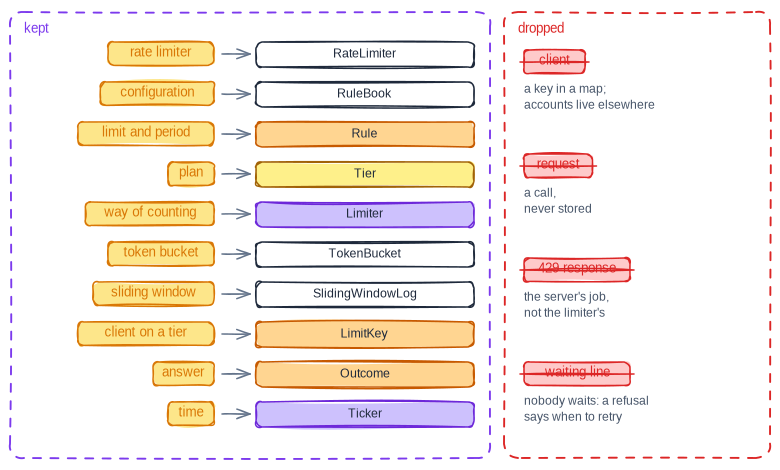
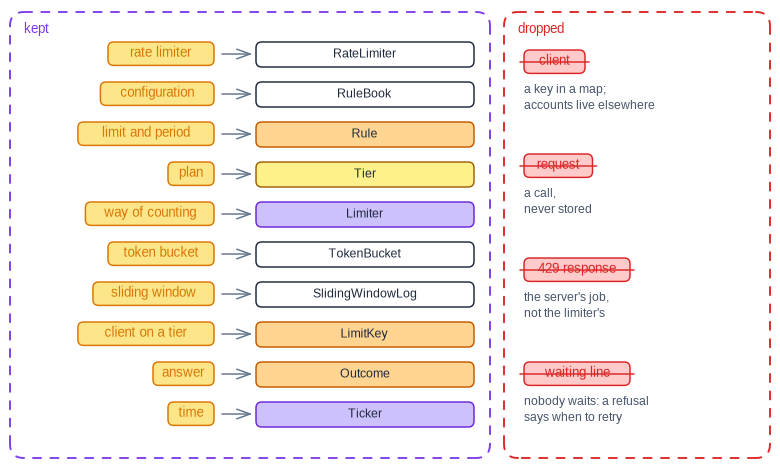
The client needs the most thought. It is the thing being limited, so it sounds like the centre of the design.
Should a client be a class?
A Client class with its tier and its own limiter
The client and its limit sit together, which reads well. But the limiter does not own clients: accounts, keys and tiers live in another service. A Client here would copy that data, and the limiter would need to keep the copy up to date.
A key: the client's id and its tier, in a map to its limiterOur pick
LimitKey is a record of two fields, and the map is the only place that ties a client to its limiter. A client that moves to another tier gets a new key and a fresh limit. The cost is that the limiter knows nothing about a client beyond its id, which is all it needs.
Data or behaviour?
Some classes only carry data and never change once created. In Java these are records. A record is a class whose fields are fixed when it is created and which gets equals, hashCode and toString without writing them.
/** Whose limit this is: one client on one tier. */record LimitKey(String clientId, Tier tier) { LimitKey { Objects.requireNonNull(clientId, "clientId"); Objects.requireNonNull(tier, "tier"); }}LimitKey is package-private, because only RateLimiter uses it. Its equals and hashCode come from both fields, which is exactly what a map key needs. Rule and Outcome are records too.
The class diagram
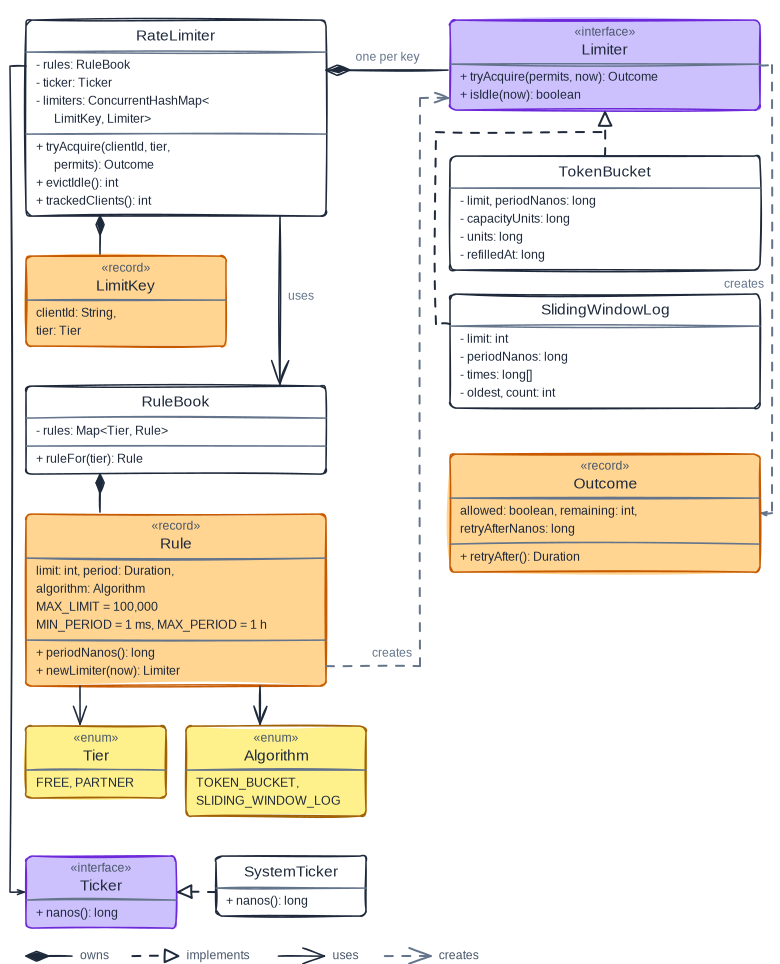
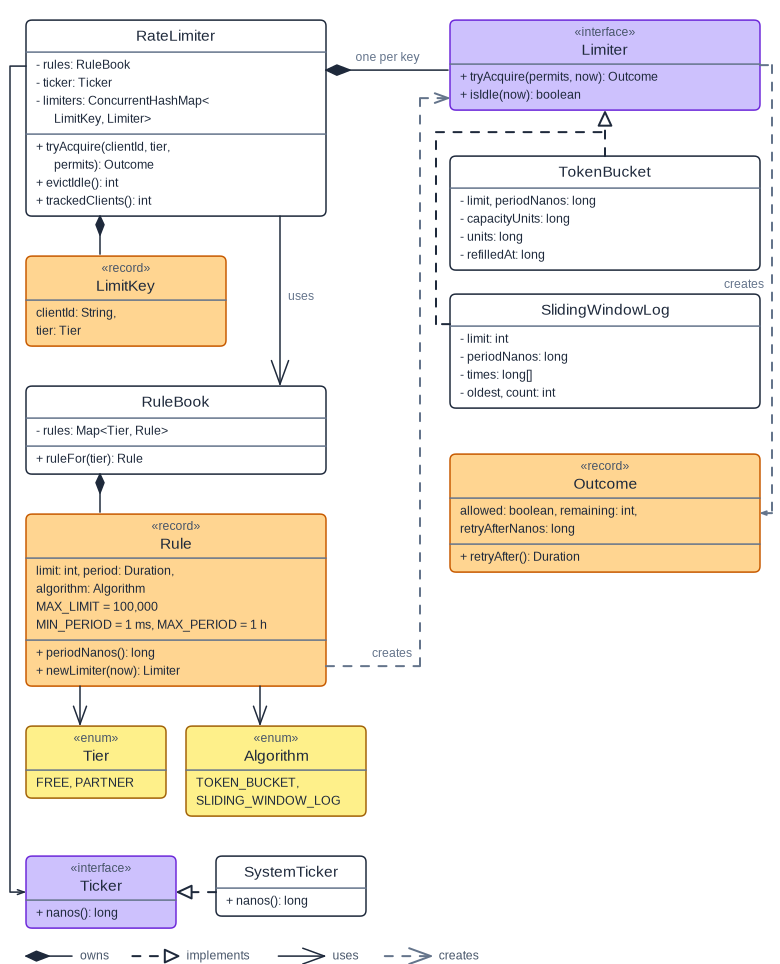
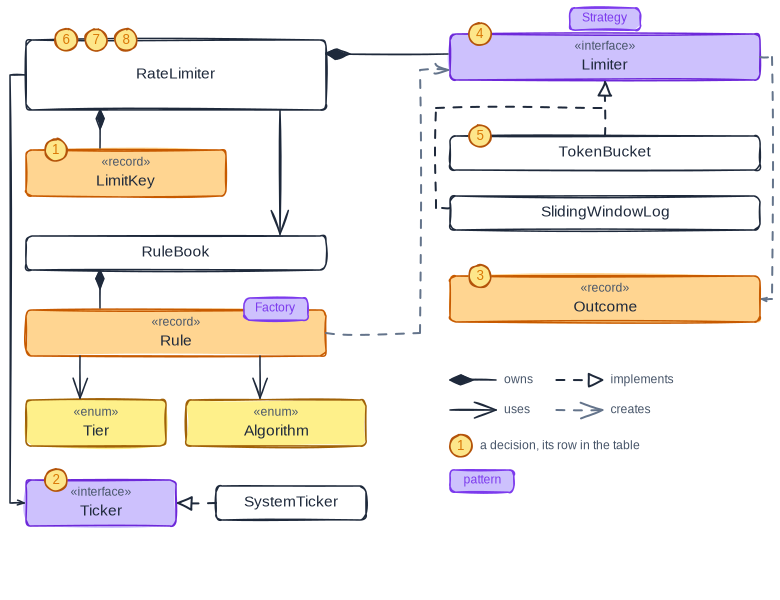
The classes fall into three groups:
- Data:
LimitKey,RuleandOutcomeare records, andTierandAlgorithmare enums.RuleBookis a small class that checks the configuration once. - The core:
RateLimiter, which owns the map of limiters and decides which lock each request takes. - Rules and outside code:
Limiter, withTokenBucketandSlidingWindowLogbehind it, andTicker, withSystemTickerfor production and a hand-moved ticker for tests.
The rest of the article builds these one at a time.
Building it
The rules
A rule is three facts: how many permits, per how long, counted which way. It checks itself when it is made:
/** At most {@code limit} permits per {@code period}, counted by {@code algorithm}. */public record Rule(int limit, Duration period, Algorithm algorithm) { public static final int MAX_LIMIT = 100_000; public static final Duration MIN_PERIOD = Duration.ofMillis(1); public static final Duration MAX_PERIOD = Duration.ofHours(1); public Rule { Objects.requireNonNull(period, "period"); Objects.requireNonNull(algorithm, "algorithm"); if (limit < 1 || limit > MAX_LIMIT) { throw new IllegalArgumentException("a limit must be between 1 and " + MAX_LIMIT + ", not " + limit); } if (period.compareTo(MIN_PERIOD) < 0 || period.compareTo(MAX_PERIOD) > 0) { throw new IllegalArgumentException("a period must be between 1 ms and 1 hour, not " + period); } } public long periodNanos() { return period.toNanos(); }A limit runs from 1 to 100,000, and a period from 1 ms to 1 hour. The upper bounds are not taste. The token bucket below multiplies the limit by the period in nanoseconds, and these bounds keep that product at most 3.6 × 10¹⁷, far below the largest long. RuleBook reads one rule per tier from the configuration:
/** One rule per tier, read from configuration and checked once at startup. */public final class RuleBook { private final Map<Tier, Rule> rules; public RuleBook(Map<Tier, Rule> rules) { Objects.requireNonNull(rules, "rules"); Map<Tier, Rule> copy = new EnumMap<>(Tier.class); for (Tier tier : Tier.values()) { Rule rule = rules.get(tier); if (rule == null) { throw new IllegalArgumentException("no rule for tier " + tier); } copy.put(tier, rule); } this.rules = copy; } public Rule ruleFor(Tier tier) { return rules.get(Objects.requireNonNull(tier, "tier")); }}It copies the map into its own EnumMap and refuses a tier with no rule. A server with a broken configuration stops at startup, not on the first request from a partner. Changing the caller's map later changes nothing here.
Time
A limiter is all about time: how long since the last request, and when the next permit is free. The code takes its time from an interface:
/** * A clock that only moves forwards, in nanoseconds from an arbitrary start. * Only the difference between two readings means anything. */@FunctionalInterfacepublic interface Ticker { long nanos();}Where does the time come from?
A java.time.Clock, the wall clock
It is the usual way to make time testable in Java. But the wall clock can be set back by a time sync, and a bucket that sees time go backwards would refill wrongly or not at all. A limiter only needs to know how much time has passed, not the date.
Call System.nanoTime() directly
It never goes backwards, which is right. But tests then have to wait for real seconds to pass, and no test can check what happens at exactly 60 s.
A Ticker interface: monotonic nanoseconds, moved by hand in testsOur pick
SystemTicker returns System.nanoTime() in production, and tests use a ticker they move themselves. Only differences between readings mean anything, so the code always compares now - then, never two raw readings. The cost is one small interface. As a guard, a bucket or a log that is given a reading earlier than its last one treats it as no time passing.
The answer
Every request gets an Outcome: allowed or not, how many permits are left, and the retry time for a refusal.
/** * The answer to one request: allowed or not, how many permits are left, and, * when it was refused, how long until the same request would be allowed if * nothing else used the limit first. */public record Outcome(boolean allowed, int remaining, long retryAfterNanos) { public Outcome { if (remaining < 0) { throw new IllegalArgumentException("remaining cannot be negative: " + remaining); } if (allowed && retryAfterNanos != 0) { throw new IllegalArgumentException("an allowed request has no retry time"); } if (!allowed && retryAfterNanos <= 0) { throw new IllegalArgumentException("a refused request needs a retry time above zero"); } } public static Outcome allow(int remaining) { return new Outcome(true, remaining, 0); } public static Outcome reject(int remaining, long retryAfterNanos) { return new Outcome(false, remaining, retryAfterNanos); } public Duration retryAfter() { return Duration.ofNanos(retryAfterNanos); }}The record refuses nonsense: a refusal with no retry time, or an allowed request with one. The server turns a refusal into a 429 response with a Retry-After header, and the remaining count into another header.
Refuse at once, or make the caller wait?
An acquire method that blocks the thread until a permit is free
The caller's code is simpler: one call and the request goes ahead. But a waiting request holds a server thread, and a busy client can tie up every thread the server has. The waiting also has to happen outside every lock, or one client stalls the others.
Refuse at once, and say how long until a retry would workOur pick
tryAcquire returns straight away. The server answers 429, and the client decides whether to wait. A caller that wants to wait can sleep for the retry time and ask again, with no lock held. The cost is that every caller must handle a refusal.
Two ways of counting
The limiter must count in two ways, picked per tier. So the counting sits behind an interface:
/** * Counts and decides for one client. It is not thread-safe on its own: * RateLimiter only calls it while it holds that client's lock. */public interface Limiter { /** Takes all the permits if all are free at {@code now}, or none of them. */ Outcome tryAcquire(int permits, long now); /** True when the limiter is back to how a new one starts, so dropping it changes nothing. */ boolean isIdle(long now);}A Limiter holds one client's count. tryAcquire takes all the permits or none and says what happened. isIdle says whether the limiter is back where a new one starts, which matters for forgetting clients later. A limiter is not thread-safe on its own: RateLimiter only calls it while it holds that client's lock.
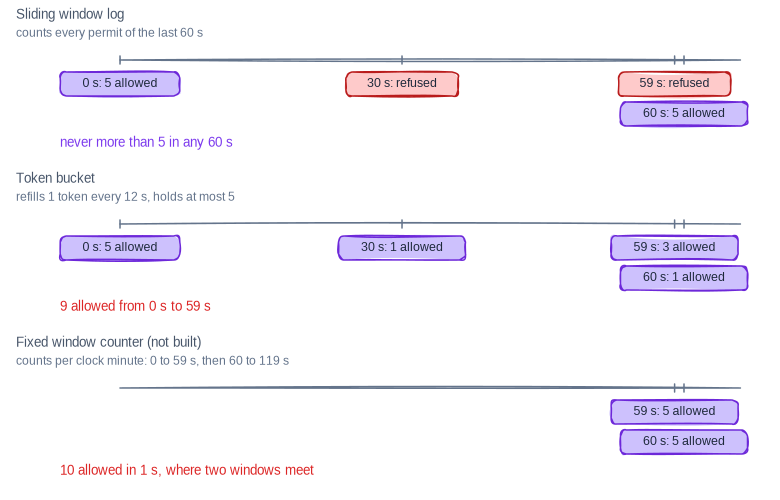
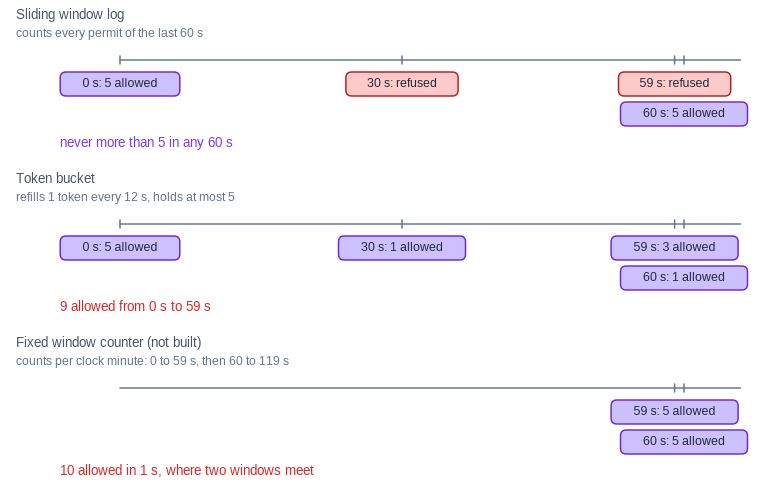
The two ways let different traffic through for the same "5 per minute":
Which way of counting?
A fixed window counter: one count per clock minute
It is two numbers per client and the simplest code. But the count resets on the minute, so a client can send the whole limit at the end of one minute and again at the start of the next: twice the limit in a second.
A sliding window counter: this minute's count plus a share of the last one
It is two numbers per client and smooths out the reset. But it guesses how the last minute's requests were spread, so it can let a few too many through or refuse a few too early.
Both a token bucket and a sliding window log, chosen per tierOur pick
The log is exact: never more than the limit in any period. The bucket allows bursts and costs two numbers per client. Each tier picks the behaviour it is sold with. The cost is two classes to write and test, and a log that keeps one number per permit, so its memory grows with the limit.
A rule makes the limiter for a new client:
/** A limiter for one client, as a new client starts: nothing used yet. */ public Limiter newLimiter(long now) { return switch (algorithm) { case TOKEN_BUCKET -> new TokenBucket(limit, periodNanos(), now); case SLIDING_WINDOW_LOG -> new SlidingWindowLog(limit, periodNanos()); }; }The token bucket
A bucket holds up to 5 tokens and refills 5 per minute, one token every 12 seconds. A request takes a token per permit. The hard part is the twelve seconds: after 7 seconds, the bucket has gained 7/12 of a token, and a long cannot hold 7/12.
public final class TokenBucket implements Limiter { private final long limit; private final long periodNanos; private final long capacityUnits; private long units; private long refilledAt; public TokenBucket(int limit, long periodNanos, long now) { if (limit < 1 || periodNanos < 1) { throw new IllegalArgumentException("limit and period must be above zero"); } // A full bucket plus one period of refill must still fit in a long. if (periodNanos > Long.MAX_VALUE / 2 / limit) { throw new IllegalArgumentException("limit times period is too large"); } this.limit = limit; this.periodNanos = periodNanos; this.capacityUnits = limit * periodNanos; this.units = capacityUnits; this.refilledAt = now; }The bucket counts in units: one token is the period in nanoseconds, 60,000,000,000 units for a minute. In those units, one nanosecond refills exactly limit units, 5 for this rule, with nothing left over.
How does the bucket count part of a token?
Tokens as a double
It is the obvious code: add elapsed × rate each time. But a double rounds, and the rounding adds up over millions of small refills, so the bucket drifts from the rule it was given.
Whole tokens only, added when a full twelve seconds has passed
It is all whole numbers. But the time since the last whole token has to be kept separately, or a client that asks every 7 seconds never gets a refill at all.
Count units of one token times the period, as a longOur pick
Every refill is an exact whole number, so the bucket never drifts, however often a client asks. The retry time is exact too. The cost is that the limit times the period must fit in a long, which is why Rule caps both.
@Override public Outcome tryAcquire(int permits, long now) { if (permits < 1 || permits > limit) { throw new IllegalArgumentException("permits must be between 1 and " + limit + ", not " + permits); } refill(now); long needed = permits * periodNanos; if (units >= needed) { units -= needed; return Outcome.allow(remaining()); } long missing = needed - units; long waitNanos = (missing + limit - 1) / limit; return Outcome.reject(remaining(), waitNanos); } @Override public boolean isIdle(long now) { refill(now); return units == capacityUnits; } private void refill(long now) { long elapsed = now - refilledAt; if (elapsed <= 0) { return; } // A whole period refills the whole bucket, so a longer gap adds nothing more. long added = Math.min(elapsed, periodNanos) * limit; units = Math.min(capacityUnits, units + added); refilledAt = now; }tryAcquire refills first, then takes all the units the request needs, or none. A refusal works out how many units are missing and how many nanoseconds refill them, rounded up: 12 s for one token when the bucket is empty. refill caps the time since the last refill at one period, because a whole period fills the whole bucket. That cap also keeps the multiplication small after a client is idle for days.
The sliding window log
The log remembers the time of every permit granted in the last period, oldest first:
@Override public Outcome tryAcquire(int permits, long now) { if (permits < 1 || permits > limit) { throw new IllegalArgumentException("permits must be between 1 and " + limit + ", not " + permits); } long at = notBeforeLatest(now); forgetOld(at); if (count + permits <= limit) { for (int i = 0; i < permits; i++) { append(at); } return Outcome.allow(limit - count); } // The request fits once this many of the oldest permits have left the window. int mustLeave = count + permits - limit; long leavesAt = times[(oldest + mustLeave - 1) % times.length] + periodNanos; return Outcome.reject(limit - count, leavesAt - at); } @Override public boolean isIdle(long now) { forgetOld(notBeforeLatest(now)); return count == 0; } /** A reading earlier than the latest one counts as the latest, so time never runs backwards here. */ private long notBeforeLatest(long now) { if (anyReading && now - latest < 0) { return latest; } anyReading = true; latest = now; return now; } private void forgetOld(long now) { while (count > 0 && now - times[oldest] >= periodNanos) { oldest = (oldest + 1) % times.length; count--; } }notBeforeLatest treats a reading earlier than the latest one as the latest, so time never runs backwards inside the log. forgetOld drops every time that is at least one period old. A permit granted at 0 s still counts at 59.999 s and is gone at exactly 60 s. The request fits if the permits still in the window plus the new ones stay within the limit. If not, mustLeave is how many of the oldest permits must leave first, and the retry time is when the last of those leaves.
The times sit in a ring buffer: an array, the index of the oldest time, and a count. It starts with 8 slots and doubles up to the limit as a client gets busier, so a client that sends one request costs about 120 bytes for the log and its 8 slots, and about 176 with its map entry and key. A client that uses a limit of 100,000 keeps 100,000 times, 800 KB. That is the price of being exact, and it is why the bucket suits large limits.
Asking for permits
RateLimiter puts it together. It checks the request, finds the rule, and does the work inside ConcurrentHashMap.compute:
/** Takes {@code permits} from the client's limit if all of them are free, and says what happened. */ public Outcome tryAcquire(String clientId, Tier tier, int permits) { Objects.requireNonNull(clientId, "clientId"); if (clientId.isBlank()) { throw new IllegalArgumentException("a client id cannot be blank"); } Rule rule = rules.ruleFor(tier); if (permits < 1 || permits > rule.limit()) { throw new IllegalArgumentException("permits must be between 1 and " + rule.limit() + ", not " + permits); } Outcome[] outcome = new Outcome[1]; limiters.compute(new LimitKey(clientId, tier), (key, limiter) -> { long now = ticker.nanos(); Limiter current = limiter != null ? limiter : rule.newLimiter(now); outcome[0] = current.tryAcquire(permits, now); return current; }); return outcome[0]; }compute runs the function with that client's entry locked. It reads the ticker, makes the limiter with that reading on the client's first request, asks the limiter, and keeps it in the map. The ticker is read after the entry is locked, so a retry time is measured from when the request actually runs, and no request decides with a reading older than one already applied for that client.
What if a request costs more than the whole limit?
Refuse it with a retry time, like any other refusal
It looks consistent. But no retry time is ever right: a batch of 6 on a limit of 5 can never fit, and the client would retry for ever.
Throw an IllegalArgumentException before anything is touchedOur pick
The server decides what a request costs, so a cost of 0 or above the limit is a bug in the server, and an exception says so. The check runs before the map is touched, so a bad request leaves no limiter behind. The cost is that the server must know the limit before it splits a big batch.
There are two kinds of error, and each says what it is for. An exception, IllegalArgumentException or NullPointerException, is for a programmer: a bad rule, a missing tier, a blank client id, a cost of 0 or above the limit. A refusal is an Outcome, an answer for a client who sent too much.
Forgetting idle clients
Each client that ever called keeps a limiter in the map. Over a day that is millions of entries, most of them for clients long gone.
/** Forgets every client whose limiter is back to how a new one starts. Returns how many it forgot. */ public int evictIdle() { int forgotten = 0; for (LimitKey key : limiters.keySet()) { boolean[] dropped = new boolean[1]; limiters.computeIfPresent(key, (k, limiter) -> { if (limiter.isIdle(ticker.nanos())) { dropped[0] = true; return null; } return limiter; }); if (dropped[0]) { forgotten++; } } return forgotten; }evictIdle walks the keys and asks each limiter, under that client's lock, whether it is idle. A bucket is idle when it is full again; a log is idle when it is empty. An idle limiter is removed. A job calls evictIdle every few minutes.
When is a client forgotten?
Never
Nothing is lost. But the map grows with every client the server has ever seen, until it runs out of memory.
When it has been quiet for a fixed time, such as ten minutes
It is easy to explain. But a client whose bucket is half empty after ten quiet minutes, on a rule of 5 per hour, would get a full new bucket: forgetting it hands out free permits.
Only when its limiter is back where a new one startsOur pick
A full bucket or an empty log behaves exactly like a new one, so forgetting it changes no answer: the next request makes a fresh limiter that says the same thing. Because the check and the removal run under the same lock as requests, a request can never slip in between. The cost is a walk over every key, so a server with millions of keys spreads it over a job, not a request.
Many threads, one client
A popular client sends requests on many threads at once, and each thread asks the limiter for the same key.
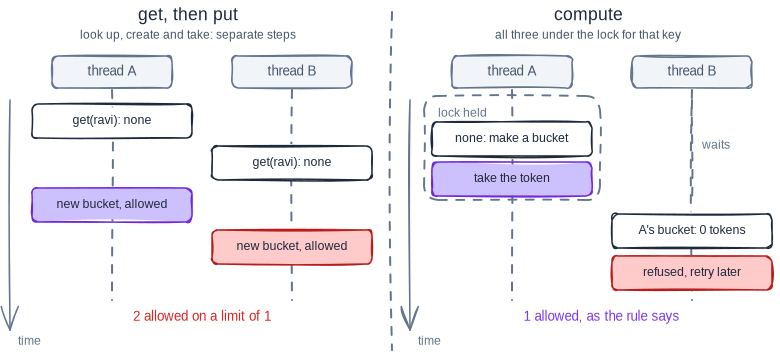
The project includes a check, demo/RaceCheck.java. Sixteen threads ask at the same moment for one permit at a time, eight times each, for one client on a rule of 50 per 10 seconds. Time stands still while they ask, so the right count is known exactly. Each round asks again 5 seconds later and 10 seconds after the start, with a new client every round, while another thread keeps calling evictIdle.
16 threads ask at once, 400 rounds per rule, a new client each round, 50 per 10s
token bucket: rounds allowing exactly 50, then 25 after 5 s, then 25 after 10 s: 400
token bucket: rounds with any other count: 0, rounds where a thread crashed: 0
sliding window log: rounds allowing exactly 50, then 0 after 5 s, then 50 after 10 s: 400
sliding window log: rounds with any other count: 0, rounds where a thread crashed: 0
clients still tracked once all were idle and evictIdle ran: 0
Every round gave exactly the counts the rules allow. The bucket allowed 50, then the 25 it refilled in 5 seconds, then 25 more. The log allowed 50, then nothing while the first 50 were in the window, then 50 once they had left. We also ran the same check with compute replaced by a get, a put, and a call to the limiter with no lock. In every run we tried, many rounds of both kinds let more requests through than the rule allows, some of them more than twice as many, and some sliding log rounds crashed. The exact numbers change from run to run, and none of it shows when one thread tests the limiter alone.
Where does the lock go?
One lock around the whole limiter
It is the simplest to get right. But every request for every client waits for every other, so the busiest client slows all the rest.
A lock inside each limiter, found with computeIfAbsent
Clients never wait for each other. But evictIdle can remove a limiter just after a thread has found it and before it takes the lock. That thread takes a permit from a limiter no longer in the map, and the next request gets a fresh one, so the client gets more permits than the rule allows. Fixing it needs a "retired" flag and a retry loop.
An atomic state changed with compare-and-set in a loop
No thread ever blocks. It fits a token bucket, whose state is two numbers. But the log's state is an array, and under heavy contention threads spin, retrying the same update.
ConcurrentHashMap.compute: the map's own lock for that keyOur pick
Making a limiter, asking it and removing it all run under the same per-key lock, so nothing can slip in between. Clients with different keys almost never wait for each other. The cost is that compute locks a small part of the map's table, so a few other keys that share it wait briefly too. The function changes the limiter, so this relies on ConcurrentHashMap running it exactly once under the lock; the field is typed ConcurrentHashMap, not ConcurrentMap, for that reason. The function must also stay short and never call back into the map. Ours reads the ticker once and changes one client's count, though a first request allocates the limiter and a large batch on a log copies its array, both under the lock.
The final design
RateLimiter is the core. It owns the map of limiters and the lock for each client, made on first use and forgotten when idle. It reaches the counting only through Limiter, the rules only through RuleBook, and time only through Ticker, so a new way of counting or a test clock changes nothing in RateLimiter.
| S.No. | The question | What we chose | Why |
|---|---|---|---|
| 1 | Should a client be a class? | A key: the client's id and its tier, in a map to its limiter | Accounts live elsewhere, and the map is the only link a limiter needs |
| 2 | Where does the time come from? | A Ticker interface: monotonic nanoseconds, moved by hand in tests | It never goes back, and tests check exact nanoseconds |
| 3 | Refuse at once, or make the caller wait? | Refuse at once, and say how long until a retry would work | No server thread is held by a waiting client |
| 4 | Which way of counting? | Both a token bucket and a sliding window log, chosen per tier | Each tier gets exact limits or bursts, as it is sold |
| 5 | How does the bucket count part of a token? | Count units of one token times the period, as a long | Every refill is a whole number, so the bucket never drifts |
| 6 | What if a request costs more than the whole limit? | Throw an IllegalArgumentException before anything is touched | It can never fit, so it is a bug in the caller |
| 7 | When is a client forgotten? | Only when its limiter is back where a new one starts | Forgetting it changes no answer |
| 8 | Where does the lock go? | ConcurrentHashMap.compute: the map's own lock for that key | Making, asking and forgetting a limiter share one lock per client |
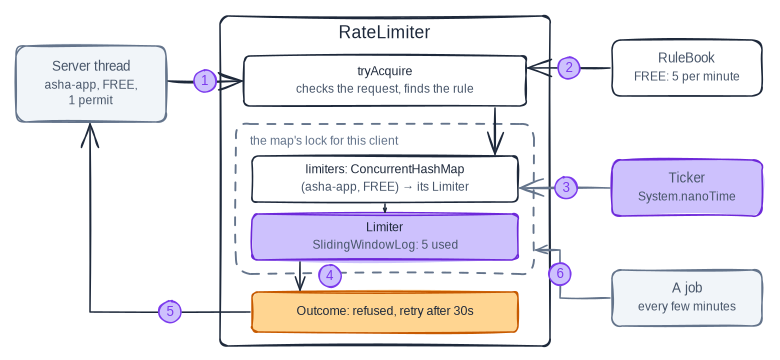
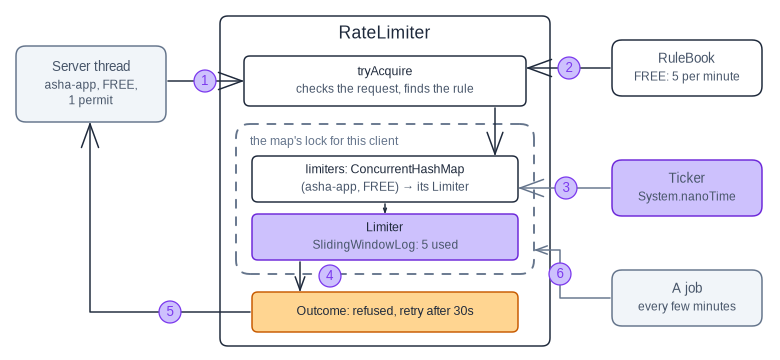
Here is the demo's request from asha-app at 30 seconds on the FREE tier, end to end:
- A server thread calls
tryAcquire("asha-app", FREE, 1). It checks the client id and the cost with no lock held, andRuleBook.ruleForgives the FREE rule: 5 per minute, counted with a sliding log. limiters.computelocks the entry for asha-app on FREE. Inside it,ticker.nanos()reads the time; the ticker is the one outside call made under the lock.- The entry already holds a
SlidingWindowLog, so no new one is made. ItstryAcquirecallsforgetOld, which keeps all five permits from 0 s, because none of them is a minute old. - Five plus one is over the limit, so
mustLeaveis 1. The oldest permit leaves at 60 s, and the log returnsOutcome.rejectwith 0 left and a retry time of 30 s. computekeeps the log in the map and unlocks the entry.tryAcquirereturns theOutcome, and the server answers 429 withRetry-After: 30.
A request on the PARTNER tier takes the same path. Only the Limiter behind the interface differs: a TokenBucket, which refills for the 30 seconds that have passed before it decides, and allows the request.
The complete code
Here is the whole project. Click any class name to jump to its file, or use Find a file to search. Badges in the tree show what each file is: a class, an interface, an enum or a record.
package limiter; import java.util.Objects;import java.util.concurrent.ConcurrentHashMap; import algorithm.Limiter;import algorithm.Outcome;import rule.Rule;import rule.RuleBook;import rule.Tier; /** * Decides, for each request, whether a client is within its tier's limit. * One limiter per client and tier, made on the client's first request and * forgotten once it is idle. All the work for one client runs inside * ConcurrentHashMap.compute, which locks that key's entry while it runs. */public final class RateLimiter { private final RuleBook rules; private final Ticker ticker; private final ConcurrentHashMap<LimitKey, Limiter> limiters = new ConcurrentHashMap<>(); public RateLimiter(RuleBook rules, Ticker ticker) { this.rules = Objects.requireNonNull(rules, "rules"); this.ticker = Objects.requireNonNull(ticker, "ticker"); } /** Takes {@code permits} from the client's limit if all of them are free, and says what happened. */ public Outcome tryAcquire(String clientId, Tier tier, int permits) { Objects.requireNonNull(clientId, "clientId"); if (clientId.isBlank()) { throw new IllegalArgumentException("a client id cannot be blank"); } Rule rule = rules.ruleFor(tier); if (permits < 1 || permits > rule.limit()) { throw new IllegalArgumentException("permits must be between 1 and " + rule.limit() + ", not " + permits); } Outcome[] outcome = new Outcome[1]; limiters.compute(new LimitKey(clientId, tier), (key, limiter) -> { long now = ticker.nanos(); Limiter current = limiter != null ? limiter : rule.newLimiter(now); outcome[0] = current.tryAcquire(permits, now); return current; }); return outcome[0]; } /** Forgets every client whose limiter is back to how a new one starts. Returns how many it forgot. */ public int evictIdle() { int forgotten = 0; for (LimitKey key : limiters.keySet()) { boolean[] dropped = new boolean[1]; limiters.computeIfPresent(key, (k, limiter) -> { if (limiter.isIdle(ticker.nanos())) { dropped[0] = true; return null; } return limiter; }); if (dropped[0]) { forgotten++; } } return forgotten; } /** How many client and tier pairs have a limiter right now. */ public int trackedClients() { return limiters.size(); }}demo/Main.java runs a public API with two tiers that have the same numbers, 5 per minute, counted two ways. It sends the same requests under both, then shows a batch call, the inputs the limiter refuses, and idle clients being forgotten:
== The same requests from asha-app under both rules, 5 per minute ==
   FREE counts with a sliding window log, PARTNER with a token bucket
    0s  5 requests  FREE: allowed 5, 0 left
                    PARTNER: allowed 5, 0 left
    0s  1 more      FREE: refused, retry after 60s
                    PARTNER: refused, retry after 12s
   30s  1 request   FREE: refused, retry after 30s
                    PARTNER: allowed 1, 1 left
   59s  5 requests  FREE: refused, retry after 1s
                    PARTNER: allowed 3, then refused, retry after 1s
   59s  allowed from 0s to 59s: FREE 5, PARTNER 9
   60s  5 requests  FREE: allowed 5, 0 left
                    PARTNER: allowed 1, then refused, retry after 12s

== A batch call costs 3 permits, and gets all 3 or none ==
   61s  3 single requests: allowed 3, 2 left
   61s  a batch of 3: refused, retry after 60s, still 2 left
   61s  2 single requests: allowed 2, 0 left

== Inputs the limiter refuses ==
   asking for 0 permits: permits must be between 1 and 5, not 0
   asking for 6 permits: permits must be between 1 and 5, not 6
   a blank client id: a client id cannot be blank
   a rule of 5 per 2 hours: a period must be between 1 ms and 1 hour, not PT2H
   a rule book with no PARTNER rule: no rule for tier PARTNER

== Forgetting idle clients ==
   70s  1,000 new clients send one request each; tracking 1,003
  130s  evictIdle forgot 1,003; still tracking 1
  190s  a minute later, evictIdle forgot 1; still tracking 0
Notice four things in the output. From 0 s to 59 s the log allowed 5 requests and the bucket allowed 9, so the bucket let almost twice the limit through in one minute, as the figure showed. At exactly 60 s the log allowed all 5 again, because its first five permits left the window together. The batch of 3 was refused with 2 permits left and took neither of them, so the 2 single requests after it went through. At 130 s every client that had gone quiet was forgotten, 1,003 of them, while meera-app, which had asked 5 seconds earlier, was kept until the next sweep.
Follow-up questions
After the core design, the interviewer adds requirements to see how the design bends. A good design absorbs most of them in one or two classes. For each one, say which class changes and which do not.
| The interviewer asks | What changes | What does not |
|---|---|---|
| "Limit each endpoint as well as each client." | LimitKey gains the endpoint, RuleBook is keyed by endpoint and tier, and tryAcquire takes the endpoint. | The limiters, the lock, evictIdle. |
| "Change the rules without a restart." | RateLimiter holds the RuleBook in an AtomicReference, and the map's value becomes a small record of the rule and its limiter. Inside compute, a limiter made from an older rule is replaced by a new one from the current rule, so a busy client picks up the change at once; the new limiter starts fresh, which gives each busy client one fresh period. evictIdle reads the limiter out of the record. | TokenBucket, SlidingWindowLog. |
| "Share one limit across many servers." | The count moves to a shared store, and the map of limiters goes away. That is a different design, with its own problems: a network call per request and a store that can fail. | Rule, RuleBook, Outcome. |
| "Use less memory for big limits." | A new SlidingWindowCounter behind Limiter, with two counts per client, a third Algorithm value, and its case in Rule.newLimiter. | RateLimiter, the other limiters. |
| "Let a request wait instead of failing." | A new acquire(client, tier, permits, maxWait) on RateLimiter that sleeps for the retry time with no lock held and asks again. | The limiters, which already say how long to wait. |
| "Let partners burst more than their steady rate." | Rule gains a burst size. TokenBucket uses it as its capacity, caps a refill at capacity ÷ limit periods instead of one, and its overflow bound becomes the burst times the period. RateLimiter checks a cost against the burst, not the limit. | SlidingWindowLog. |
| "Send the remaining permits in a header." | Nothing in the limiter: every Outcome already carries them. | Everything. |
| "Limit clients that have no API key." | Nothing in the limiter: the server passes another id, such as the IP address. | Everything. |
In most rows the change lands in one class or behind one interface. The shared limit is the one to say out loud as a different question, because it replaces the map with a store and brings failures the in-memory design never has.
What the interviewer looks for
Mid-level
A mid-level candidate shows a working limiter for one client: a map from client to a counter or a bucket, a refusal over the limit, and a reset or a refill. They explain one way of counting clearly and test it at the boundary.
Senior
A senior candidate shows everything above and gives the reasons. They compare a token bucket with a sliding window and say what each lets through, put the counting behind an interface, and take time from an injected ticker. They make the refill exact, return a retry time, and guard each client with its own lock.
Staff+
A staff candidate leads the conversation through the trade-offs without being asked. They explain why only an idle limiter can be forgotten, why the lookup, the creation and the removal must share one lock, and why the ticker is read under it. They say where the in-memory design stops and what a shared store would change.
Common mistakes
- A fixed window called a sliding one. A count that resets on the minute lets twice the limit through where two minutes meet.
- Tokens as a
double. Rounding adds up over many small refills, and the bucket drifts from its rule. - Reading the wall clock. A time sync can move it backwards, and tests have to wait for real time to pass.
- Get, then put. Two first requests each make a limiter, and a limit of 1 allows 2.
- Forgetting clients by age. A half-empty bucket replaced by a full one hands out free permits.
- Blocking the thread until a permit is free. One busy client can hold every thread the server has.
- A refusal with no retry time. The client can only guess, and guessing clients retry too often.
Summary
- Ask what "5 per minute" means. "Never more than 5 in any minute" and "5 at once, then one every 12 seconds" are different algorithms.
- Put the counting behind one interface, with a sliding window log for exact limits and a token bucket for bursts, chosen per tier.
- Count the bucket in units of one token times the period, so every refill is a whole number and nothing drifts.
- Take time from an injected monotonic ticker, and compare only differences between readings.
- Refuse at once with a retry time, and throw for a cost that can never fit.
- Forget a client only when its limiter is back where a new one starts, so forgetting changes no answer.
- Do every step for one client inside
ConcurrentHashMap.compute, so making, asking and forgetting a limiter share one lock.