Why you are doing this at all
On 25 April 2023, US Pacific time, water from a cooling pipe reached one of the three buildings of Google Cloud's Paris region, europe-west9, and a fire followed. Each building has its own power, cooling and networking, so losing one should have cost the region only that building's share. Instead, the region's control planes and its identity and access management (IAM) service failed in all three buildings for most of a day.
The servers in the other two buildings still had power. The problem was the database the control planes write to, a regional Spanner. It accepts a write only when a majority of its three replicas agree, and two of the three were in the building that was shut down. Google's report says it should have had one replica in each building.
So the region had three buildings for its servers and, in effect, one building for its writes. Copying servers to more places is easy, because a server holds nothing you can't rebuild from an image. The hard part is the data, and above all the place where each write is accepted.
A multi-region design is a decision about where each write is accepted. Disaster recovery is a rehearsed way to move that decision to another region when the first one fails.
When you don't need a second region
Most failures stay inside one region. An availability zone, or zone, is one or more datacentres with their own power, cooling and network, within about 2 milliseconds of the other zones in the region. If you run every database as a quorum across three zones, losing a zone loses no data and costs a failover of seconds. AWS's reliability guidance says this protects against fires, floods and major power cuts. Do this first, in every design.
A second region protects against the whole region failing. Two recent AWS outages in us-east-1 show what that looks like, and neither was a building failing. On 7 December 2021, congestion on AWS's internal network there broke many of its services for about 7 hours, with some services slower to recover. On 19 and 20 October 2025, a race in the automation that manages DynamoDB's Domain Name System (DNS) records left its us-east-1 endpoint with no addresses at all. The effects lasted about 14 and a half hours.
If the business can live with a day's outage every few years, backups copied to another region are enough, and they cost almost nothing. That's a valid design. Say it with the numbers attached.
Objectives, tiers and what they cost
RPO and RTO
Two numbers state the requirement, and each one buys something different.
The recovery point objective (RPO) is how much acknowledged data a failure may lose, measured in seconds of writes. Replication and leader election defines it the same way. Synchronous replication gives an RPO of zero. Asynchronous replication gives an RPO equal to the replication lag. A backup gives an RPO equal to the time since the last backup.
The recovery time objective (RTO) is how long users wait before they're served again. It depends on how much of the other region is already running, and on how fast somebody decides to use it.
So RPO buys a replication mode, and you pay for it in write latency. RTO buys standby capacity, and you pay for it every month, whether or not a disaster ever comes.
Set the two numbers per kind of data and per kind of failure. Losing a zone, losing a region and a bad write, such as a DELETE with the wrong WHERE, each need their own pair. Replication answers the first two. Only a backup answers the third, because replication copies the bad write to every region within a second. AWS's guidance says that after corruption, the recovery point is always some time before the problem was found.
Zone failure against region failure
Zones are close, so surviving one is cheap. A round trip between zones takes 0.5 to 2 ms, by the table in latency numbers that matter. So a quorum across three zones commits in about 2 ms with an RPO of zero. Regions are far apart. Microsoft measures the round trips between its Azure regions. They are under 30 ms to a nearby region, about 70 ms across the US, and about 70 to 90 ms from the US East Coast to Western Europe.
Zones only help if every quorum is spread across them. Europe-west9 had three buildings, but its Spanner had two of three replicas in one of them. So a building failure, which the design was meant to survive, stopped writes for the whole region.
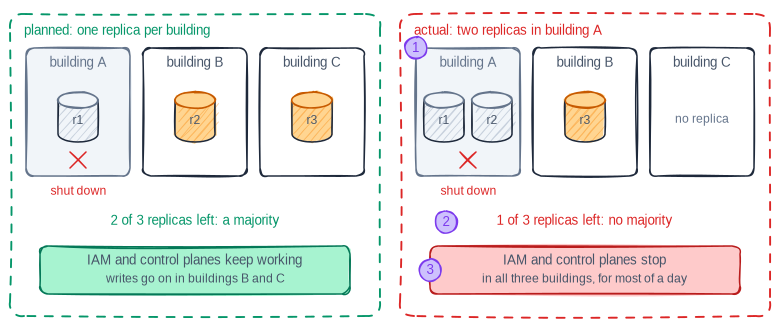
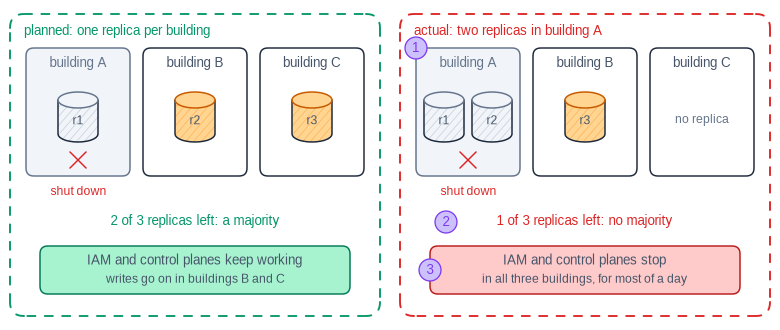
Run the same check on your own databases, queues and lock services. Europe-west9's two replicas in building A were in two different clusters, so a count by cluster looked spread out. Count replicas by the building, or whatever they physically share, not by the cluster or zone label they carry. Then confirm that a majority is left after you remove any one building.
Four tiers, by how ready the other region is
The tiers are named by what is already running in the recovery region before the disaster. The RPO and RTO ranges are AWS's, from its Well-Architected reliability guidance.
| tier | running in the recovery region | RPO | RTO |
|---|---|---|---|
| backup and restore | nothing; backups are copied there | hours | up to 24 hours |
| pilot light | the databases, replicating; no servers | minutes | tens of minutes |
| warm standby | a scaled-down copy of everything | seconds | minutes |
| active-active | the whole system, serving users | near zero | potentially zero |
The tiers differ in how much work is left to do after the disaster. Backup and restore has to build the network, start servers, restore every database from backup and deploy the code. The restore is the slow step: GitHub's restores from backup in 2018 took hours, mostly moving and loading the data.
Pilot light already has live database replicas, so it starts and scales servers, promotes the replicas and moves traffic. Warm standby is already running, so it scales up, promotes and moves traffic. AWS separates the two with one test: a pilot light can't serve a request until somebody acts, and a warm standby can serve some traffic at once. A warm standby kept at full size is called a hot standby. Active-active only stops sending users to the failed region.
You avoid each of those steps by paying for something every month. To price the tiers, count what each one keeps running in the second region.
The question is what each tier costs every month,
before any disaster. One region of an example system:
100 application servers, 20 cache nodes, and a database
of 4 nodes (primary, zone standby, 2 read replicas).
124 machines. Writes: 5,000 a second of 1 KB each.

Always on in the second region
  backup and restore    backups only                 0
  pilot light           database replica and its
                        zone standby                 2   ≈   2%
  warm standby          database 2, app servers 10,
                        cache 2                     14   ≈  11%
  hot standby           everything, idle           124   =  100%

Active-active: any one region must be able to fail
  2 regions   each sized for all of it    2 × 124  = 248   +100%
  3 regions   each sized for half of it   3 × 62   = 186    +50%

Copied between regions in every tier but the first
  5,000 × 1 KB          = 5 MB/s  ≈ 432 GB a day
  ─────────────────────────────────────────────────────
  Pilot light and warm standby cost about a tenth of the
  primary or less. The step to hot standby or active-active
  costs half to all of it again.
An RTO shorter than a warm standby can scale means paying for a second system. AWS notes that most teams who build a full second copy then use it active-active, since they are paying for it anyway.
What distance costs a write
Once data lives in two regions, you pay for the distance between them either on every write or on the day you fail over. Replication and leader election works through both in detail, with the arithmetic.
Synchronous, or by quorum across regions: a write waits for a round trip to at least one other region, and the RPO is zero. Spanner's multi-region configurations have two read-write regions and a witness replica in a third. DynamoDB's strongly consistent global tables need exactly three regions and also give an RPO of zero.
Asynchronous: a write is acknowledged in its own region and copied afterwards, so it costs no extra latency. DynamoDB's default global tables copy a write typically within a second, and their documentation gives the RPO as the replication delay, usually a few seconds. AWS says Aurora's global database typically replicates in under a second.
The asynchronous window
With asynchronous replication, the region that accepts a write acknowledges it first and ships it afterwards. If that region fails, every write inside the lag at that moment has been acknowledged to a user and exists only in the failed region. Those writes are stranded. If the region is destroyed, they're lost. If it comes back, they conflict with whatever the new region accepted in the meantime.
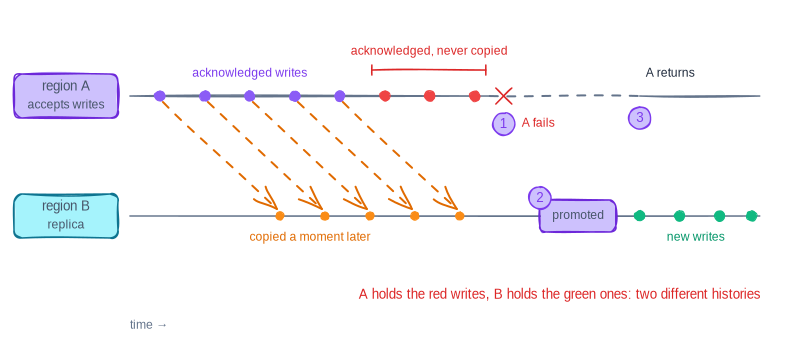
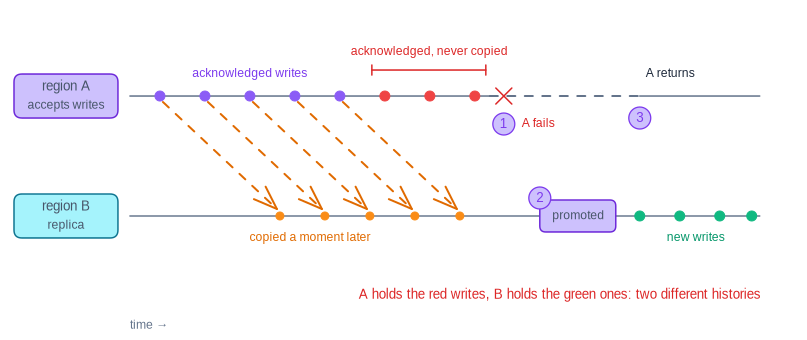
The window that matters is the lag at the moment of failure, not the average. Lag is a queue: it grows whenever writes arrive faster than the other region applies them, as replication and leader election works out. If a region slows down before it stops, writes queue and the lag grows. So the window at the moment of failure can be far larger than the usual lag.
Who accepts a write
Every multi-region design has to answer one question for each piece of data: which region accepts its writes? Reads are easy, because any region with a copy can answer a read that may be a little stale. A write has to be accepted somewhere, and that place decides whether two writes conflict.
The answer also sets the write latency for users far from that place. Take a user on another continent, 150 ms from the write region, whose request makes three writes in a row.
The question is how long a request with 3 writes in a
row takes, depending on where the database that accepts
them sits.

Write region on another continent, 150 ms away
  app server near the user, database far away
    3 writes × 150 ms                       = 450 ms
  request sent once to an app server in the
  write region, writes done there
    1 × 150 ms + 3 × ~1 ms                  ≈ 153 ms

Write region is the user's own region
    3 writes × ~1 ms                        ≈   3 ms
  ─────────────────────────────────────────────────────
  Sending each write across a continent costs 450 ms.
  Sending the request once costs 150 ms. Writing in
  the user's own region costs about 3 ms.
GitHub's 2018 incident shows the first line of this worksheet. After its databases were promoted to the West Coast, its East Coast applications paid a cross-country round trip on most database calls. Its post-incident report names that sudden latency as a major factor in the 24 hours of degraded service.
Every region accepts every write
It's tempting because every user writes locally, and there's no replica to promote when a region fails. DynamoDB's global tables work this way by default.
It breaks when two regions change the same item inside the replication window. DynamoDB keeps the write with the later internal timestamp and drops the other, with no error to anyone. A conditional write checks only the copy in its own region, so two users can both claim the username alice, one in each region, and both get a success. Transactions are atomic only in the region that ran them, so another region can see half of one.
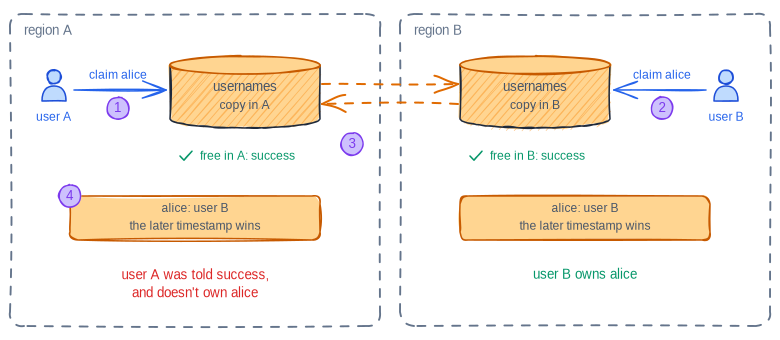
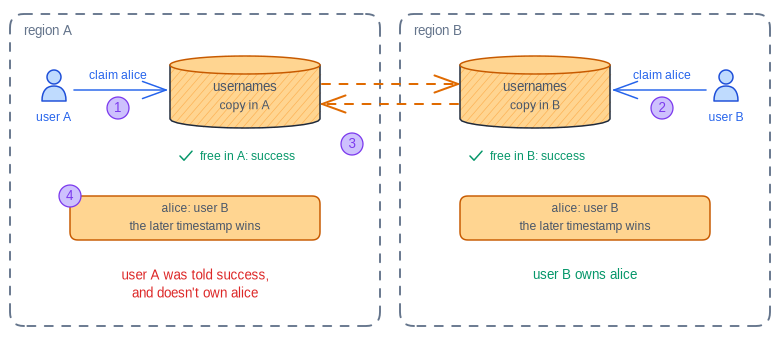
This is fine for data where each write states the whole value and either order is acceptable, such as a session record. Key-value store uses it for exactly that. A logout is the exception, because a later last-seen write can bring a deleted session back. Auth: sessions, JWT and OAuth keeps revocation in its own record for that reason. For anything with a rule across writes, it's the wrong default. If such data must be written in every region, replication and leader election lists three answers. One is a conflict-free replicated data type (CRDT), whose copies can always be merged. The others are a merge written in the application, and one home region per key.
One write region, with the others reading and standing by
All writes go to one region, and the others hold asynchronous replicas that serve reads and wait to be promoted. AWS calls this write global. It is how change data capture and distributed cache arrange their databases.
There are no conflicts, because one region decides every write. The cost is distance and size. A user on another continent pays at least 150 ms per write request, and 450 ms if the application sends each write separately. The whole write load sits in one region. And when that region fails, all the writes move at once, and the users near the old region start paying the distance.
One write region per key, not per system
Question the idea that the system needs one write region. Each key needs one, which is a different requirement. Give each user, tenant or account a home region, usually the one nearest them, and send that key's writes there. Reads can still come from any region. AWS calls this write partitioned.
Every key still has exactly one region that decides its writes, so there are no conflicts. But most users now write in their own region: about 3 ms instead of 150 to 450 ms, by the worksheet above. When a region fails, only the keys homed there move, and the other regions carry on as before.
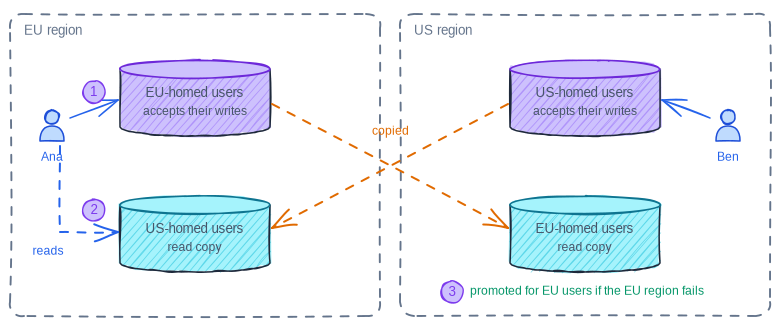
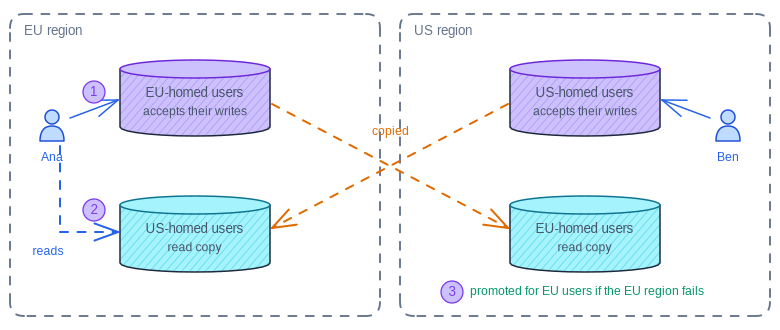
What you give up: data that spans keys still needs one decider. A username must be unique across all users, and a transfer between users homed apart touches two regions. Keep those few tables in one region, or in a database that commits by quorum across three regions. The router needs each key's home on every request, so it reads a small directory and caches it. And moving a user's home is a small failover of its own: stop their writes, wait for the replica to catch up, then switch.
Several breakdowns in this course end up here. Ticketmaster homes each show in the region nearest its venue. Uber homes each city. WhatsApp places each conversation near its members. Most multi-region designs turn out to have one write region per key, and a good one says which region that is.
Failover: who decides, and how traffic moves
A failover moves two things. The right to accept writes moves to a new region, and users' traffic follows it.
The hard part is the decision. Region failures are often partial. In 2021, AWS's running instances in us-east-1 kept working while the APIs to launch new ones failed. A health checker outside a region that sees no response can't tell a dead region from a broken network path between itself and the region. Those two cases need opposite responses.
So who decides that a region has failed, and what stops the old region from carrying on with writes?
Fail over automatically on health checks
It gives the shortest RTO, and nobody has to wake up.
But a false alarm is expensive. Each failover loses the asynchronous window and usually needs a failback later, which means moving the writes back, so AWS's guidance says to use automatic failover with caution. Worse, a network split makes the old region look dead while it is still accepting writes. The automation promotes the new region, and now two regions accept writes. Replication and leader election walks through GitHub's 2018 failover, where 43 seconds of this cost 24 hours.
A person decides, and automation does every step
AWS recommends this: start the failover by hand, but script every step so that starting it is "like the push of a button". Use data plane operations, the parts of a cloud service that handle live traffic, and avoid control plane operations, the APIs that change configuration.
In the 2021 outage, Route 53's APIs failed for about 7 hours, so nobody could change a DNS record, while existing records kept answering queries. A failover that edits DNS records would have stalled. AWS's answer is to wire the records to health checks in advance and fail over by flipping a health check, which is a data plane operation.
A warm standby can't be all data plane, because scaling up uses Auto Scaling, a control plane service. AWS's alternative is hot standby, already running at full size. That's the trade in the first worksheet: a tenth of the fleet plus a control plane step, or all of the fleet and none.
The cost is the decision itself. Paging people and agreeing on what is happening adds minutes to the RTO, and Google's Site Reliability Engineering (SRE) book notes that human intervention scales poorly. And if the old region is cut off but alive, the script can't reach it to stop its writes.
Make the old region stop itself: write authority as a lease
Question the idea that someone must tell a dead region from a cut-off one before acting. Make the old region stop itself instead. A region may accept writes only while it holds a lease, a grant that expires unless renewed. It renews the lease through a small consensus group, such as etcd, with members in three regions. The check sits in the region's commit path: before it commits a write, the region confirms by its own clock that the lease hasn't expired. A region that is cut off can't reach a majority to renew, so its lease runs out and it stops accepting writes. When the writes are moved, the new region takes the lease only after the old one has expired, plus a margin.
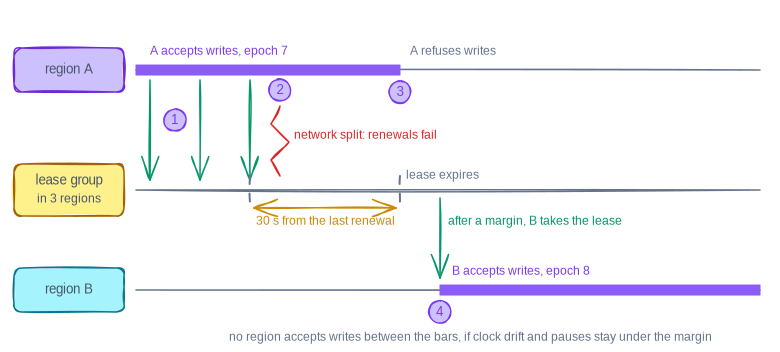
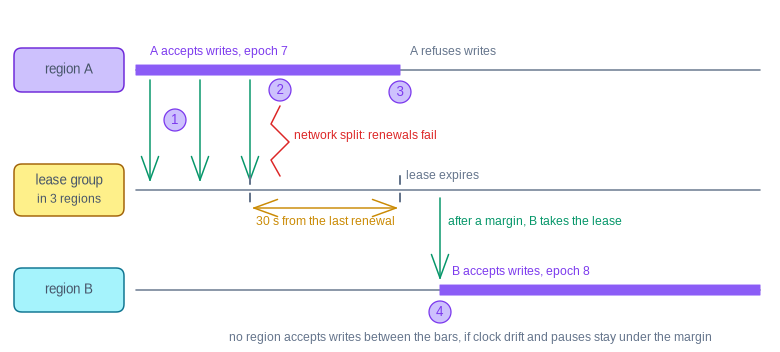
The lease limits how long the old region keeps writing. Without it, a cut-off region keeps accepting writes for as long as the split lasts, at the same time as the new one. With a 30 second lease, the old region stops at most 30 seconds after its last renewal, before the new one starts. Its stranded writes still exist, and failback still has to handle them, but they cover at most those 30 seconds plus the lag.
That holds only while clock drift and process pauses stay under the margin. A server that pauses between checking the lease and committing can wake up and commit after the lease has passed to B. Fencing and epochs explains why nothing can prevent that.
So every write also carries the epoch of the lease it was accepted under. During the split, A's database never sees epoch 8, so the epoch doesn't stop A. It keeps A's writes out of B's data: the step that applies A's changes to B, the replication apply path or the reconciliation job, refuses anything with an older epoch. Postgres and MySQL replication don't check this for you, so you build the check into that step.
What you give up: the failover waits 30 to 40 seconds for the lease, and you need a third region to host the lease group. If the lease group loses its majority, no region can renew, and writes stop everywhere. People still decide the unclear cases, such as a region that is slow rather than gone. A wrong decision gives two writers at once only if a clock or a pause beats the margin, and the epoch keeps those writes out of B's data.
Moving the traffic comes after the write authority. DNS is a common tool for moving whole regions. Its caches keep sending some clients to the old address well past the TTL, the time a client may keep a DNS answer, as load balancing shows. That is acceptable for an evacuation measured in minutes, and too slow for anything needed in seconds. Anycast addresses, such as AWS Global Accelerator, avoid client caching because the address never changes. Netflix originally moved traffic in steps by proxying requests from the failing region to healthy ones, then changed DNS.
In a warm standby failover, the database is the quick part. Add up the steps and see where the time goes.
The question is which step to spend on to cut the RTO.
Lines marked "assumed" are round figures, not measured.

As first built
  detect: alarms over 5 one-minute periods         5 min  assumed
  decide: page, join a call, agree                10 min  assumed
  promote the database replica                     1 min
  scale the app servers up to full load           35 min
  move traffic: DNS change and its tail            5 min  assumed
  ─────────────────────────────────────────────────────
  total                                           56 min
  the database promotion                      1/56 ≈ 2%

With capacity held ready and a trigger agreed in advance
  detect                                           5 min  assumed
  decide, against a written trigger                2 min  assumed
  promote                                          1 min
  add the held capacity                            4 min
  move traffic                                     5 min  assumed
  ─────────────────────────────────────────────────────
  total                                           17 min
  held capacity is billed whether or not it runs,
  so this moves the cost toward hot standby

The promotion figure is AWS's for Aurora's global database,
under a minute. The 35 and 4 minutes are Netflix's measured
times to scale up and to add held capacity. Capacity and
the decision are most of the hour.
Netflix measured the slow part of its own failover. Its regional failover took about 45 minutes, and about 35 of those went on waiting for the healthy regions to scale up. So it kept a shadow cluster of instances for each service, hidden from metrics and from service discovery. During a failover, those instances joined the live clusters in about four minutes, and by 2018 the whole failover took seven. It used capacity Netflix had already reserved, enough to absorb the loss of any one of its three regions.
Failback
The old region recovers, and you want your writes back. Its data is now wrong in two ways. It is missing everything written since the failover, which went to the new region. And it holds the stranded writes from the asynchronous window, which the new region never received.
So don't reuse the old region's database as it is. AWS's guidance is to rebuild it as a replica of the new primary, which often means deleting the old one. Before you delete it, copy out everything in its log after the last position the other region received. Those are the stranded writes. Some can be applied again, if the operation is idempotent and still makes sense against current data. The rest go to people.
GitHub did this in 2018. Both of its sites held writes the other lacked, so it couldn't safely fail back. It restored from backups, resynchronised the replicas in both sites, and only then moved its primaries back. It also kept the old primaries' binary logs. One of its busiest clusters had 954 writes that hadn't been copied, and GitHub began sorting them into those it could reconcile automatically and those that needed contact with users.
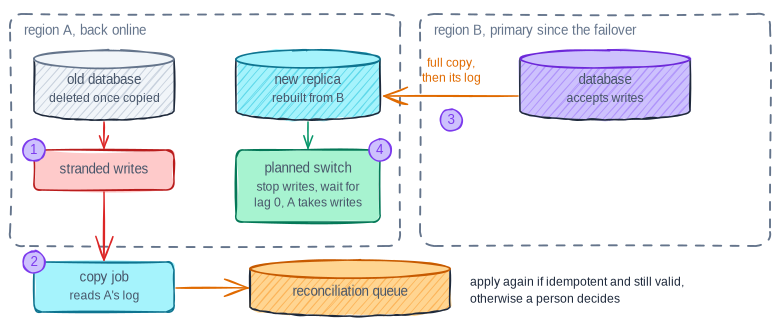
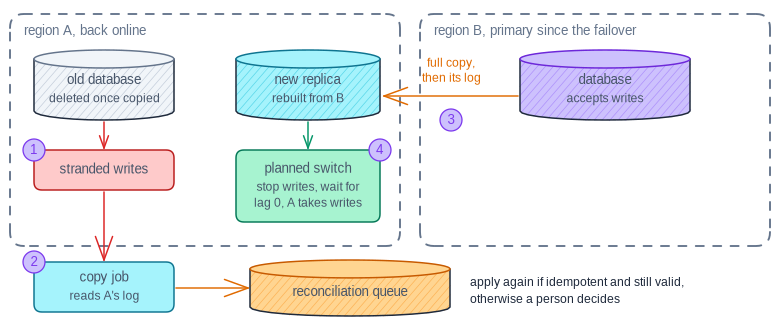
The switch back is a planned failover, so it can lose nothing. Stop writes, wait for the replica to catch up, then move. Or skip it, and make the recovery region the new primary. AWS notes that some teams swap their primary and recovery regions on a schedule, every three months, for example. A team that does this runs its planned switch four times a year.
Data residency
Some laws limit where data may be stored or sent. Under Article 44 of the EU's General Data Protection Regulation (GDPR), personal data may go to a country outside the EU only under the conditions of the regulation's Chapter V. If data must stay in a country that has one cloud region, it can't be replicated to another country at all. AWS's guidance says multi-region then doesn't suit that workload, and multiple zones become its protection.
A home region per key fits this: an EU user's home is an EU region, and their backups and replicas go to another EU region. The problems come from elsewhere. Logs, analytics pipelines, caches and support tools copy personal data to wherever they run, so list them in the same review.
Testing: game days and evacuation drills
Google's SRE book puts it this way: "you only know that you can recover your recent state if you actually do so." The same is true of a failover. Until it has run, its RTO is a guess.
Three kinds of test, cheapest first:
- A restore drill. Restore last night's backup into the recovery region and time it. That time is the largest part of your RTO for backup and restore.
- A game day. Simulate a failure on purpose, at a planned time, with the team watching. Fault injection tools can pause replication to and from one region, so you see what the application does.
- A region evacuation. Move real traffic out of a healthy region during working hours, in steps, and measure how long it takes and whether the other regions hold the load.
Google's disaster recovery testing, DiRT, requires every test to have a plan for rolling it back. It also tests people: one kind of test makes an engineer unavailable, to find the knowledge only that person has.
The method
1. List the data, and give each kind two numbers. Give an RPO and RTO for losing a zone, losing a region and a bad write. Orders and a product catalogue rarely share an answer.
2. Survive a zone first. Put every quorum across three zones, and check that no building, or anything else the replicas physically share, holds a majority of any group.
3. Pick the tier from the region RTO, and price it. Count what runs in the second region every month. Pilot light and warm standby cost about a tenth of the primary or less. Hot standby and active-active cost half to all of it again.
4. Pick replication from the region RPO. Use asynchronous replication for most data, with the lag measured and alerted on. Use a quorum across three regions for the small set that can lose nothing.
5. Decide where each write is accepted. Choose one region, or a home region per key. Name the data that spans keys, and give it one decider.
6. Write the failover. Say who decides, what stops the old region writing, which steps need a control plane, and whether the surviving regions can carry the load.
7. Write the failback, then run both. Rebuild the old region from the new one, handle the stranded writes, and rehearse the whole thing as a drill.
Worked examples, start to finish
Each example breaks a different obvious answer.
An internal tool, where the tier is bigger than the requirement
A finance team uses a reporting tool: 300 staff, office hours, and a 500 GB Postgres database. Someone asks for it to be multi-region. The obvious answer is active-active in two regions.
Ask for the two numbers first. The team can work without the tool for a day, and re-entering an hour of edits would be annoying but harmless. So for a region loss, the RTO is 8 hours and the RPO is 1 hour.
Backup and restore is the tier to try first. AWS gives it an RPO of hours, and continuous backups with point-in-time recovery bring that down to as little as 5 minutes, well inside the hour. Its RTO is up to 24 hours, so whether it meets 8 depends on how long the restore takes, and only a drill can tell you that. Active-active would double the machines, by the first worksheet, and add conflict handling that no requirement asked for.
The decision is continuous backups copied to a second region, the infrastructure written as code, and a restore drill every quarter that times a full restore there. If a drill takes longer than 8 hours, move up one tier to pilot light. That adds a live database replica in the second region, and still no servers.
A checkout, where one RPO doesn't fit all the data
A shop runs warm standby across two regions. Orders, payments, stock and the product catalogue live in one Postgres, replicated asynchronously to the second region, and the lag is normally under a second. The shop charges the card before it confirms the order. The obvious answer is an RPO of about a second for everything.
The question is how many acknowledged orders a region
failure strands at peak, and whether a second of lag
is as small as it sounds.

  orders at peak                              300/s

Lag at its usual level
  1 s × 300/s                              =   300 orders

Lag when the region fails, while degraded
  30 s × 300/s, assumed                    = 9,000 orders

Each of these orders has its card already charged by
the payment provider, which sits outside both regions.
  ─────────────────────────────────────────────────────
  Up to 9,000 customers charged for orders the recovery
  region has never seen.
Losing 30 seconds of catalogue edits means someone types them again. Losing 9,000 paid orders means refunds, support tickets and angry customers. One RPO for the whole database prices both the same.
So split the data by RPO. Orders and payments move to a database that commits by quorum across three regions, such as Spanner or CockroachDB. Each order write then waits for the nearest other region, about 25 ms in the replication article's example, in a checkout that already waits on a card payment. The catalogue and sessions stay asynchronous, because they can be re-entered or rebuilt. So do stock levels, which can be recounted from the orders.
Keep a second net as well. After any failover, a job compares the payment provider's charges with the orders, and confirms or refunds each charge that has no order. Ticketmaster runs that job against Stripe before a promoted region reopens sales.
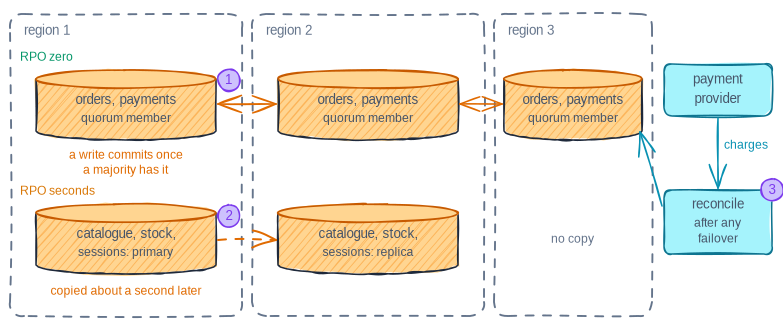
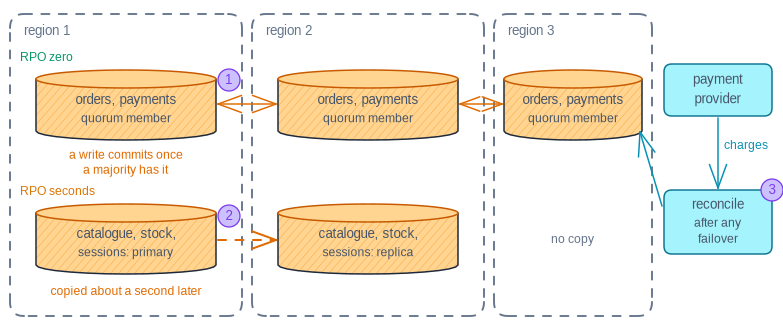
The decision is two RPO classes in two data stores. Orders and payments get zero, and everything else gets seconds. Reconciliation covers the gap between your data and the payment provider's.
Two active regions at 70 percent, where failover is an overload
A team runs active-active in two regions, each serving half the users at about 70 percent of its capacity. It says there's no failover to plan, because both regions are already live. AWS's guidance agrees that active-active has no failover as such, and lists the question to test instead: can the other regions handle all the traffic?
The question is whether one region can carry the other's
users the moment it fails. Each region runs at 70% of
its capacity, and its cache answers 99% of reads.

Capacity
  surviving region's load        2 × 70%    = 140%

Database reads behind the cache
  normal: its own users' misses  1% of 1x   = 0.01x
  after: own misses + moved users, all
  missing a cold cache           0.01 + 1   = 1.01x
  increase                       1.01 / 0.01 ≈ 101x

Highest safe load per region with N regions,
any one able to fail: (N − 1) / N
  N = 2                                        50%
  N = 3                                        67%
  N = 4                                        75%
  ─────────────────────────────────────────────────────
  At 70% in two regions, the survivor is 40% over its
  capacity, and its database faces about 100 times its
  usual reads until the cache fills.
The cache line is the same arithmetic as the blast radius in caching strategies and invalidation. Distributed cache reaches the same conclusion about a region failover: the moved users' keys were never in this region's cache.
The decision is three regions, each kept under 60 percent, below the 67 percent ceiling. Today's load spread over three regions of today's size is 47 percent each. In capacity, three regions under 60 percent add up to about 2.3 of today's regions, and two regions under 50 percent add up to 2.8. Move a failed region's users over in steps rather than all at once, and shed optional work while the caches fill.
Where it goes wrong
These are ordered by how often they come up.
1. Naming a tier without the two numbers
"Active-active" or "multi-region" with no RPO and RTO can't be checked, and it often buys more than the requirement asks for. State both, for each kind of data, then pick the cheapest tier that meets them.
2. Treating replication as the backup
Replication sends a bad write to every region within a second. Every tier, including active-active, needs point-in-time backups and a restore that has been tested.
3. A failover that depends on the failed region
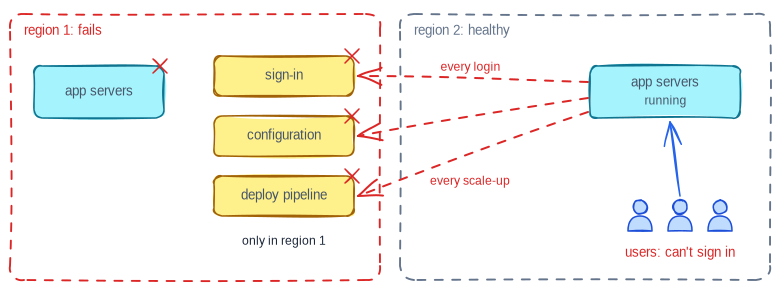
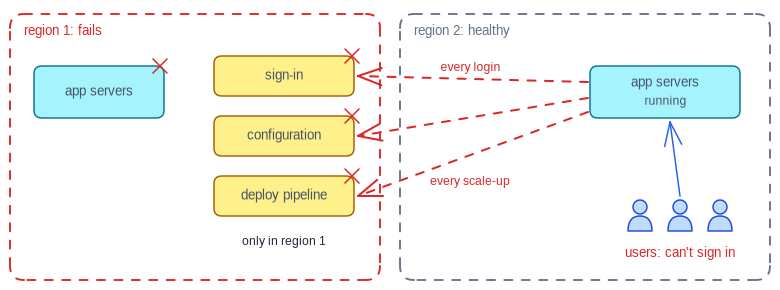
The failover tools, the sign-in service, the deploy pipeline or the DNS changes may live in only one region. In October 2025, root and federated sign-ins to the AWS console failed in regions outside us-east-1, as well as inside it. In 2021, AWS's own status dashboard couldn't fail over to its standby region. Check every step of the runbook for where it runs, and for which steps need a control plane.
4. A surviving region that can't take the load
Two regions at 70 percent means the survivor runs at 140 percent, behind a cold cache. Run each region under (N − 1) / N of its capacity, check service quotas in the recovery region, and move users across in steps.
5. Promoting a new region without stopping the old one
A network split makes a live region look dead. If the old region can still accept writes, you now have two write regions and two histories. Fence it with a lease it checks before each commit, and an epoch checked wherever its writes are applied, before you promote.
6. No plan for the stranded writes
An asynchronous failover leaves acknowledged writes in the old region. Without a plan, they're either lost when you rebuild it or merged in a hurry later. Copy them out, then reconcile them deliberately, and agree in advance who decides the cases a script can't.
7. Never running it
A failover that has never run has never been timed, so its RTO is a guess. Run restore drills and region evacuations on a schedule, and use the measured time as your RTO.
If you memorise nothing else
| fact | why it matters |
|---|---|
| Servers are easy to copy; the right to accept a write is not | the design is where each write is accepted |
| RPO buys a replication mode, RTO buys standby capacity | one costs write latency, the other costs every month |
| Zones are 0.5 to 2 ms apart; US regions up to about 70 ms | surviving a zone is nearly free, a region is not |
| Zones help only if no building, or anything else replicas share, holds a quorum's majority | europe-west9 lost writes across the region to one building |
| Backup, pilot light, warm, active-active: RTO hours, tens of minutes, minutes, near zero | pick by RTO, not by the word "multi-region" |
| Warm standby costs about a tenth of the primary; active-active half to all of it again | the price jump is between warm and hot |
| Asynchronous RPO is the lag at the moment of failure | and lag grows when a region slows down |
| The system's RPO is its slowest replication stream | object copies can trail database rows by minutes |
| Last-writer-wins drops a write without an error | conditional writes check only the local copy |
| Most multi-region designs are one write region per key | a home region per user keeps writes local and conflict-free |
| Fence the old region before promoting the new one | a lease stops it by its own clock, and an epoch keeps out what slips past |
| Promoting the database is 1 minute of a 56-minute warm standby failover, in the worksheet's example | capacity and the decision are the rest |
| With N regions, run each under (N − 1) / N of its capacity | two regions at 70 percent fail into 140 percent |
| Failback rebuilds the old primary and reconciles stranded writes | it is a planned switch, so it can lose nothing |
| Every tier needs tested backups | replication copies a bad write everywhere |
What is expected at each level
Mid-level
Know the difference between losing a zone and losing a region, and that zones are the default protection. Define RPO and RTO, and name the four tiers in order. Know that asynchronous replication can lose the writes inside the lag.
You aren't expected to raise fencing, home regions or failback without being asked. If the interviewer asks "what happens when the region goes down?", a good mid-level answer names the standby. It says the standby may be a few seconds behind, and that traffic moves to it.
Senior
You lead this part of the discussion, and three things must come up without prompting.
RPO and RTO as numbers, per kind of data. Then the tier they buy and what it costs every month. A tier with no numbers can't be checked.
Where each write is accepted, and what a failover loses. One write region or a home region per key, the replication mode, and the window of stranded writes.
Who decides to fail over, and what stops the old region. A person, or a lease with an epoch on every write. Say what each costs in RTO: the lease adds its length, and the epoch adds nothing.
Two things are disqualifying: active-active with every region writing and no conflict policy, and synchronous replication across continents for every table without pricing it.
Staff+
Producing a correct design is still the bar. A staff answer stands out by spending the budget where the requirement is.
Split the data by RPO. Use zero RPO across three regions for the small set that can't be lost, asynchronous replication for the rest, and reconciliation for the gap with anything outside your system.
Home writes per key. Most users write locally, a region failure moves only its own keys, and the few tables that span keys get one decider.
Make the old region stop itself. Hold write authority as a lease through a three-region group, and put an epoch on every write, checked wherever writes are applied.
Size the survivors. Keep each region under (N − 1) / N, plan for caches that start cold, and move users across in steps.
And say what you would not build. Each of these can cost a team a quarter.
One is active-active for an internal tool with an 8-hour RTO. Another is every region accepting writes with last-writer-wins for data that has rules across writes. A third is synchronous cross-region replication for every table, when one small set needed it.
Another is a hot standby that sits idle when warm standby meets the RTO. Another is a failover orchestrator that calls control plane APIs it could avoid, such as editing DNS records during the outage. And the last is copying caches between regions, when each region can fill its own.
Sources
The tier ranges, outage timelines and replication figures below come from these documents; the worksheets work out the rest from the inputs they state.
- AWS Well-Architected, REL13-BP02 Use defined recovery strategies, and the whitepaper Disaster recovery options in the cloud. The four tiers and their ranges, data plane over control plane, and manual initiation with automated steps. Also write global, local and partitioned, Aurora's times, failback, scheduled region swaps and data residency.
- AWS post-event summaries for 7 December 2021 and 19 to 20 October 2025 in us-east-1. Route 53's APIs failing while DNS answers kept working, the status dashboard's failed failover, the empty DynamoDB DNS record and the sign-in failures in other regions.
- Google Cloud, europe-west9 incident report, 2023. Three buildings, two of three Spanner replicas in one of them, and the regional loss of quorum.
- DynamoDB global tables, Spanner instance configurations and S3 Replication Time Control. Last-writer-wins, region-local conditional writes and transactions, three-region strong consistency, and the 15-minute object window.
- GitHub, October 21 post-incident analysis, 2018. Writes on both coasts, the unsafe failback, the restore from backups, the 954 unreplicated writes and the cross-country latency.
- Amjith Ramanujam, How Netflix does failovers in 7 minutes flat, 2018. The 45-minute failover, 35 minutes of scaling, shadow clusters and capacity for one region.
- Google's SRE book: Data Integrity on restores, and Managing Critical State on human intervention in failover.
- Microsoft, Azure network round-trip latency statistics. Measured median round trips between regions, for the nearby, cross-US and transatlantic figures.
- Jesus Climent, Shrinking the time to mitigate production incidents, Google Cloud, 2019. DiRT's rule that every test has a rollback plan, and its test of people.
- GDPR Article 44, on transfers of personal data outside the EU.