The shape
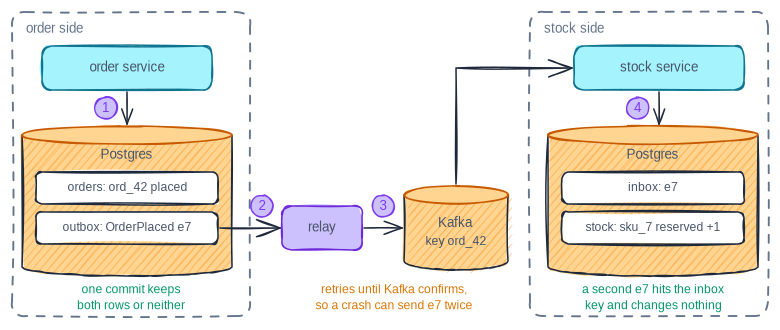
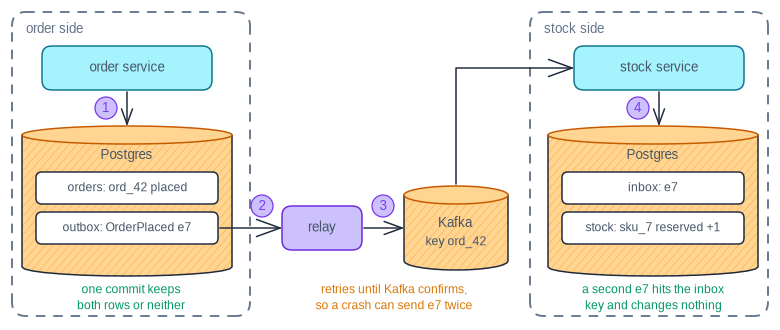
A service saves an order and then sends an OrderPlaced event to Kafka. Those are two writes to two systems, and no transaction covers both. If the process dies after the commit and before the send, the order exists and nothing downstream hears about it. This is a dual write, and retrying cannot fix it, because the retry does not know how far the first attempt got.
The outbox moves the second write into the first system. In the same transaction as the order, the service inserts a row describing the event into an outbox table. The commit keeps both rows or neither. A separate process, the relay, reads the outbox afterwards and sends each row to Kafka, retrying until Kafka confirms. Because the relay retries, an event can be sent twice. Idempotency and Exactly-Once Delivery explains why that trade is right: a lost event cannot be repaired, and a repeated one can.
In any system, when a change in one place has to reach another, write the message in the same transaction as the change, and deliver it later from what you wrote. The outbox is a queue that lives inside your database. The commit puts work on it, and the relay is its consumer. So every hard decision about it is a queue decision: how the relay reads it, in what order, how it gets emptied, and how far behind it may fall.
The same fix applies in two other places. Sending a welcome email after signup is a dual write with the email provider, and the fix is a table of emails to send, written by the signup transaction. And a consumer that has to remember which messages it has handled is the same pattern facing the other way, called an inbox.
The mechanism
The outbox row
The row is the event, not a copy of the order. The aggregate is the thing the event is about, here one order, and aggregate_id names it.
CREATE TABLE outbox (
  id             bigint GENERATED ALWAYS AS IDENTITY PRIMARY KEY,
  event_id       uuid        NOT NULL DEFAULT gen_random_uuid(),
  aggregate_type text        NOT NULL,  -- 'order': picks the topic
  aggregate_id   text        NOT NULL,  -- 'ord_42': the message key
  event_type     text        NOT NULL,  -- 'OrderPlaced'
  payload        jsonb       NOT NULL,
  created_at     timestamptz NOT NULL DEFAULT now(),
  sent_at        timestamptz            -- NULL until the relay sends it
);
CREATE INDEX outbox_pending ON outbox (id) WHERE sent_at IS NULL;

BEGIN;
UPDATE orders SET status = 'placed' WHERE id = 'ord_42';
INSERT INTO outbox (aggregate_type, aggregate_id, event_type, payload)
VALUES ('order', 'ord_42', 'OrderPlaced', '{"order_id": "ord_42", "total": 4200}');
COMMIT;
The payload is written for the consumers, so it is a contract. If consumers instead read raw row changes from the database's log, every one of them depends on your columns. Message Queues vs Event Streams counts that as the cost of change data capture (CDC).
The relay loop, and where it can crash
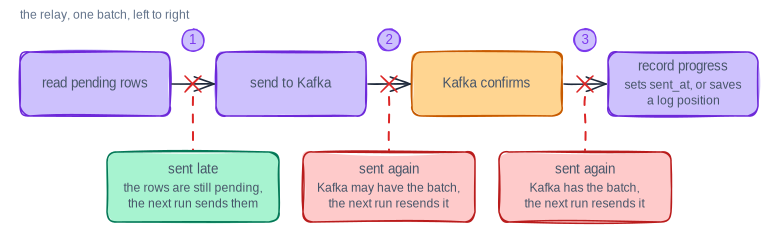
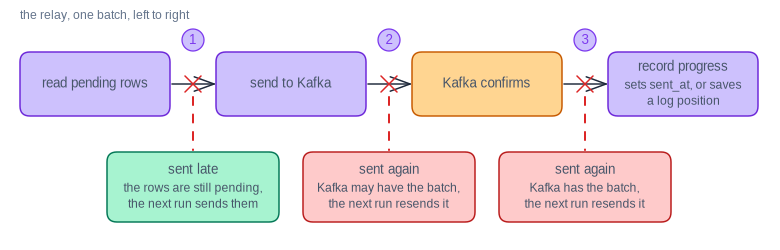
Every relay runs the same loop. It reads a batch of pending events, sends them to Kafka, waits for Kafka to confirm, then records how far it got. A crash can happen between any two steps, and none of them loses an event. So every event arrives at least once, and some twice.
Polling the table, or tailing the log
Polling. A loop asks the table for pending rows, sends them and marks them sent.
Log tailing. A CDC connector, such as Debezium, reads the database's write-ahead log (WAL), the log it writes every change to before applying it, and sends each committed outbox insert.
A polling relay is a few lines of SQL around a Kafka producer.
-- every 200 ms, or straight away if the last batch was full
BEGIN;
SELECT id, event_id, aggregate_type, aggregate_id, event_type, payload
FROM outbox
WHERE sent_at IS NULL
ORDER BY id
LIMIT 500
FOR UPDATE;
-- send the batch to Kafka and wait for every confirmation;
-- $1 holds only the ids whose send succeeded
UPDATE outbox SET sent_at = now() WHERE id = ANY($1);
COMMIT;
FOR UPDATE locks the rows it returns until the commit, so a second relay running the same query waits instead of sending them too. At the course's 2,000 events a second, each 200 ms poll finds about 400 rows.
Do not poll with a high-water mark, the highest id the relay has seen, as in WHERE id > last_seen. An id is handed out when a row is inserted, but the row becomes visible only when its transaction commits. Transaction A can take id 100 and transaction B id 101, and B can commit first. The relay reads 101, moves its mark past it, and never asks for 100 again. Gunnar Morling describes this failure in his 2024 review. Polling for sent_at IS NULL does not lose row 100. It sends it late, after 101.
Log tailing reads the commit instead of the table. On Postgres, the connector reads through a replication slot, a named position in the WAL that the database keeps for one reader. Postgres hands the connector each transaction in the order it committed, and never one that rolled back, so it cannot skip a row the way a high-water mark can.
Debezium's outbox event router expects columns like the ones above. It sends each outbox insert to a topic named after the aggregate type, such as outbox.event.order, keys it by the aggregate id, and ignores deletes. So the service can delete the outbox row in the same transaction that inserts it. The insert is in the log, and the table stays empty.
On Postgres you can drop the table altogether. pg_logical_emit_message(true, 'outbox', payload) writes a message into the WAL, and the connector receives it in commit order. The true makes the message part of the current transaction, so a rollback discards it. SeatGeek described running this in 2025, with Debezium reading the messages.
The cost moves from the table to the log. A slot keeps every byte of WAL its reader has not confirmed, even when nothing is connected. By default Postgres puts no limit on that, so if the connector stays stopped, the disk fills.
Keeping nothing in the table also makes the log the only copy of any event the connector has not read. If that copy is lost, a fresh snapshot of the empty outbox cannot bring the events back, and no error is raised.
Postgres can lose that copy in two ways. If you set a limit on a slot's WAL or on its idle time, Postgres invalidates a slot that passes the limit, and the connector cannot resume from it. And a failover loses the slot unless the standby keeps a copy of it. Postgres 17 added this as failover slots.
Either keep sent rows for a window, so they can be read again, or use failover slots with no limit set, and watch the disk.
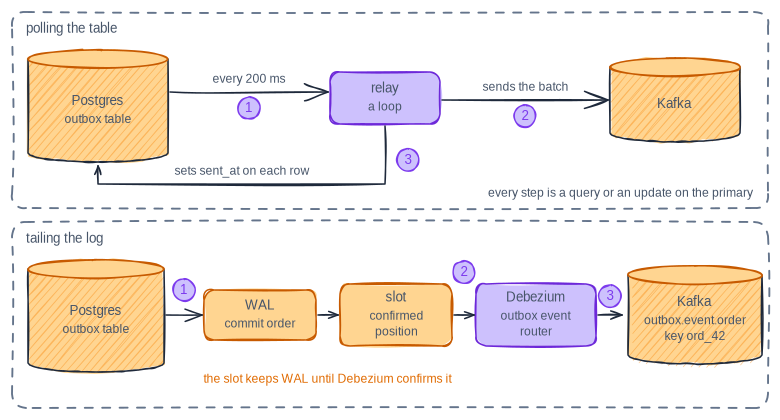
Take polling if you do not already run Kafka Connect, the framework Debezium usually runs on. It is one query and one loop, and its failures show up in your own code. Move to log tailing when you need lower delay, when polling load shows on the primary, or when you already run Debezium.
Ordering, per aggregate
Like any queue, the outbox keeps order only within a key. A single global order would mean one relay and one Kafka partition. Consumers need only one order's events in the order they happened: placed, then paid, then shipped. Three links have to keep that order.
The outbox ids follow the order's history. Update the order row before inserting the outbox row. The update locks the row, so a second transaction on ord_42 waits at its own update until the first commits, and only then takes a higher outbox id. If the code inserts the outbox row first, the second transaction can take a lower id before it blocks, and its event sorts ahead of the one it follows.
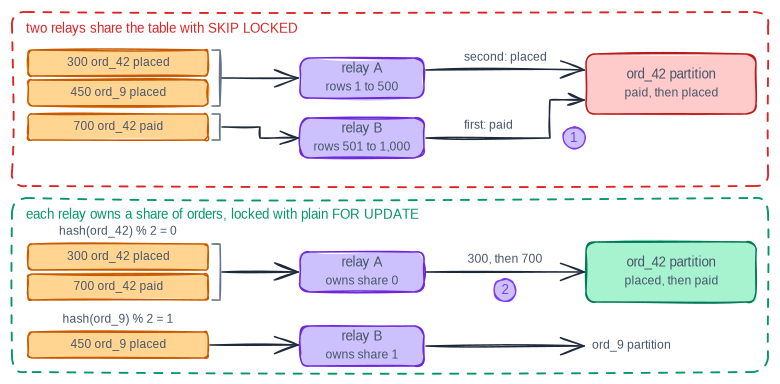
One relay sends all of an order's events. Adding SKIP LOCKED to the query lets several relays drain the table at once, because each relay skips rows another one has locked. Then one order's events can land in two batches. If the second batch finishes first, the later event reaches Kafka first.
So run one active relay with a standby, or give each relay a fixed share of orders, such as the orders where hash(aggregate_id) % N equals its number. Either way, lock with plain FOR UPDATE. A relay that takes over then waits for the old relay's locks, instead of skipping an order's earlier row and sending a later one.
With Kafka's default settings, a stuck relay can hold those locks for up to 2 minutes while the producer retries a send. A Postgres timeout on idle transactions ends the stuck relay's session and frees the locks. A log reader needs none of this, because one connector reads the slot in commit order.
The key holds the order inside Kafka. With aggregate_id as the key, one order's events share a partition, and by default Kafka's producer keeps their order when it retries a send. If one event will not send, the relay holds back that order's later events rather than skip ahead.
Duplicates, and the inbox on the other side
Because the relay sends at least once, a consumer will receive some events twice. The fix is the inbox. In one transaction, the consumer inserts the event id into an inbox table with a unique key, and applies the change. For a repeat, the insert adds no row, so the consumer rolls back, commits its Kafka offset and moves on.
BEGIN;
INSERT INTO inbox (event_id, received_at)
VALUES ($1, now())
ON CONFLICT (event_id) DO NOTHING;
-- 0 rows inserted: a repeat, so ROLLBACK and commit the offset
UPDATE stock SET reserved = reserved + 1 WHERE sku = 'sku_7';
COMMIT;
The update adds 1, a write that is unsafe to repeat. The inbox makes it safe, because the insert and the update commit together or not at all.
Keep inbox ids for as long as a repeat can arrive. If the outbox keeps 7 days of rows for replay, the inbox needs at least 7 days of ids.
Emptying the table
On a polling outbox, each event is three row writes: the insert, the update that sets sent_at, and a later delete. In Postgres, an update or a delete leaves the old version of the row behind as a dead row. Until vacuum, the Postgres cleanup process, removes them, the poll has to step over their index entries.
Vacuum falls behind while any long transaction is open, because it cannot remove a row that transaction might still see. Brandur measured this on a Postgres job queue in 2015. With one transaction left open for an hour, lock time reached 15 times normal at its peaks, and the queue grew to 60,000 jobs. The polling relay holds its transaction open while it sends, so keep the send short.
The course sizes the outbox at 2,000 events/s, about 200 B
a row, kept 7 days so the relay can replay them. The question
is how to remove old rows: one at a time, or a day at a time.

Rows
  per day        2,000 × 86,400            =  172.8M
  kept           172.8M × 7                =   1.21B
  size           1.21B × 200 B             ≈  242 GB

Deleting sent rows
  deletes        same as the insert rate   =  2,000/s, all day
  dead rows      2,000 updates/s + 2,000 deletes/s
                                           =  4,000/s for vacuum

Dropping one partition a day
  deletes                                  =  0
  dead rows      2,000 updates/s           =  2,000/s for vacuum
  removal        one DROP TABLE, 172.8M rows, once a day

Partitioning by day halves the dead rows vacuum has to clear
and removes the delete load entirely.
Partition the table by day on created_at, and drop the oldest partition each night. Before each drop, check the partition for rows where sent_at IS NULL, and page someone instead of dropping it. A log-tailing outbox can keep its window the same way.
A row that can never be sent, such as one over Kafka's size limit, is moved on purpose to a dead-letter table, a table for events that failed. There a person decides what happens to that order's later events.
Relay lag, the number to alarm on
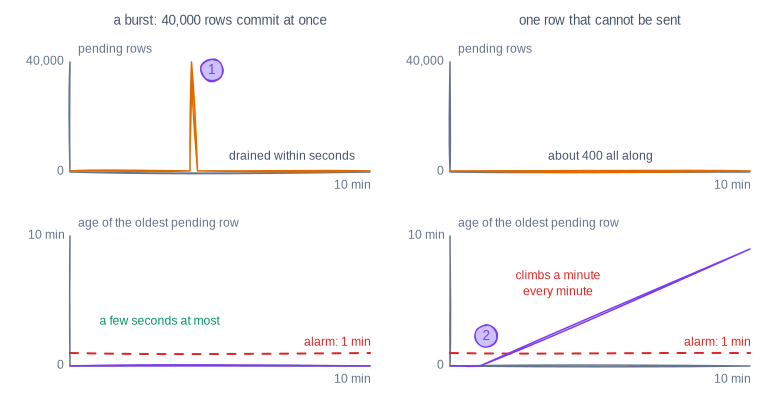
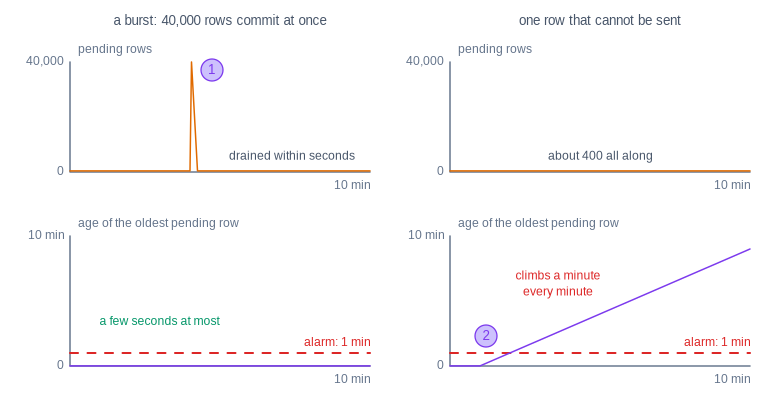
As with any queue, alarm on how long the oldest item has waited, not on how many are waiting.
SELECT coalesce(
  (SELECT now() - created_at FROM outbox
   WHERE sent_at IS NULL ORDER BY id LIMIT 1),
  interval '0') AS oldest_pending;
A healthy relay keeps this near one poll interval, 200 ms. A stuck one makes it grow by a second every second. The row count can stay flat while one row fails again and again, for example because its payload is over Kafka's default size limit of about 1 MB.
For log tailing, watch the slot instead. In the pg_replication_slots view, pg_wal_lsn_diff(pg_current_wal_lsn(), confirmed_flush_lsn) gives how many bytes of WAL the connector has not confirmed.
While Kafka is down, orders keep committing and their events
wait in the table. Afterwards the relay sends the backlog and
the new events at the same time. The question is how long
until events are on time again. The course's figures: 2,000
events/s, a poll every 200 ms, at most 500 rows per poll.

Backlog after a 10 minute outage
  rows           2,000 × 600 s             =  1.2M

Polling on a fixed 200 ms timer
  capacity       500 / 0.2 s               =  2,500 rows/s
  spare          2,500 − 2,000             =    500 rows/s
  catch-up       1.2M / 500                =  2,400 s, 40 min

Polling again at once when a batch comes back full
  assume one full batch (read, send, mark) takes 50 ms
  capacity       500 / 0.05 s              = 10,000 rows/s
  spare          10,000 − 2,000            =  8,000 rows/s
  catch-up       1.2M / 8,000              =    150 s

Sleeping 200 ms after every 50 ms batch
  capacity       500 / 0.25 s              =  2,000 rows/s
  spare          2,000 − 2,000             =      0 rows/s
  catch-up                                 =  never

The timer is for an idle relay. A relay that waits for the next
200 ms tick after a full batch turns a 10 minute outage into
50 minutes of late events, and one that sleeps after every
batch never catches up.
How to tell you have this problem
A handler commits and then sends. Any code path that commits and then calls a broker client, an email API or a webhook is a dual write.
Downstream counts drift. List yesterday's order ids that have no OrderPlaced event in the consumer's data. A few missing ids clustered around deploys and broker incidents are sends lost between a commit and a send.
When you do not need one
You need an outbox when an event has to leave your database and must not be lost. In each case below, one of those is false, or the database already keeps the queue for you.
The event can be lost. Clicks and metrics can be sent after the commit, best effort.
The database already exports an ordered log. DynamoDB Streams records each change to a table exactly once, in order for each item, and keeps it for 24 hours. Its consumers need no outbox table, and a consumer that is down for more than 24 hours loses events.
The event is the write. A service that writes only to Kafka and builds its tables from it has no second write. It can no longer read its own writes straight after a request.
What it costs
Every event arrives late. A flow that needs the result before the user's next request has to read from the source.
The primary does more work. Polling adds an insert and an update per event, and five polls a second, on the database that takes every order. Log tailing moves it to a connector and a slot you have to run.
Where it shows up in the course
| article | the form it takes there |
|---|---|
| Change Data Capture | the event is written in the same transaction as the change and read from the log afterwards |
| Design a Distributed Job Scheduler | the firing commits first and the queue send follows; the partition's next owner resends every QUEUED run, and the start query is the inbox |
| Design a Distributed Message Queue | Kafka transactions cover only Kafka's partitions, so a service writes an outbox row and a relay publishes it |
| Design a Payment System | the processor's answer, the payment's state, the ledger transaction and the event commit together, so no one hears of a payment the database doesn't have |
| Distributed Transactions and Sagas | each hop of a choreographed saga: an outbox on the sending side and an inbox on the receiving side |
| Dropbox and Google Drive | the journal row and its reference increments commit together, and a relay carries them to the block index |
| Idempotency and Exactly-Once Delivery | the fix for a dual write, priced per business write, and the outbox row written with a signup so that the welcome email is always attempted |
| LSM Trees vs B-Trees | the polling outbox inserts, updates and deletes every row, which is the dead-row load a B-tree store has to vacuum |
| Message Queues vs Event Streams | the senior answer to publishing an order event, with change data capture as the staff answer and the reason the outbox alone only approximates commit order |
| Notification Service | the producer's outbox row carries the notification request and its idempotency key, so a redelivered request is dropped |
| Ticketmaster Booking | the confirm writes the order, tickets and an outbox row in one commit; the relay captures the payment and issues the tickets |
| Uber Ride-Hailing | requesting and completing a trip each write their event in the trip's transaction, for payments, receipts and the archive |
| Write-Ahead Logs | an outbox read by tailing the WAL ties the log's size on the primary to the reader's health |
Getting it wrong
Sending inside the transaction. The send can succeed and the commit fail, which leaves an event for an order that does not exist.
Polling with id > last_seen. A row that commits after a higher id was read is never sent. Poll for sent_at IS NULL.
Reaching for Kafka transactions. Kafka's exactly-once guarantee covers only Kafka, as Confluent says. KIP-939, a Kafka Improvement Proposal that would let Kafka join a two-phase commit, is not released. Morling points out that it would need both systems up for every commit.
Leaving a replication slot unwatched. A slot whose connector stopped keeps WAL until the disk fills. It also stops vacuum from removing old rows in the system catalogs, and in extreme cases that forces Postgres to shut down to prevent transaction ID wraparound.
Sources
Product behaviour comes from each project's own documentation, and the sizing uses the course's figures.
- Debezium: outbox event router, FAQ, MySQL connector. Routing, keys and repeats.
- Gunnar Morling, the 2019 outbox post, on deleting the row in the inserting transaction, and Revisiting the Outbox Pattern (2024), on polling that misses rows and KIP-939.
- SeatGeek, The Transactional Outbox Pattern (2025). A team running
pg_logical_emit_message. - PostgreSQL: SKIP LOCKED, slots, commit order, pg_replication_slots, slot settings, idle transactions, pg_logical_emit_message, partitions, 17 release notes. Brandur, Postgres Job Queues & Failure By MVCC (2015), on open transactions and queue tables.
- Kafka producer and broker settings, Confluent's exactly-once post, KIP-939 and its open issue, and DynamoDB Streams.