Most candidates prepare for a system design interview as though the finished diagram were the thing being marked. They practise a feed, a chat app and a URL shortener until the boxes come out right. The boxes matter, but they are only part of what gets graded.
Interviewers record what they see against a rubric, a short list of qualities their company fixed in advance. The hiring decision is made from that record. Google's guide to structured interviewing encourages interviewers to take detailed notes "so they can later be reviewed throughout the hiring process." Meta's guide for candidates says it from the other side: "Interviewers can only assess your skills and abilities based on what you show them during your interview."
You are scored on what the interviewer writes down, and they can only write down what you said or drew.
What the companies publish
Four sources say in public what a system design interviewer looks for.
| company | what it publishes | how a grade is written |
|---|---|---|
| Meta | Four focus areas for the design round | Not published |
| Amazon | Six objectives for the design, and tips | Not published; decided at a debrief |
| Rubrics, the same for every candidate for a role | Rubric anchors (re:Work): outstanding, solid, borderline, poor | |
| Medium, 2016 | Its full grading rubric | Strong No to Strong Yes, each with written facts |
Meta publishes the most specific list for the design round. Its guide says "it will be up to you to drive the conversation," and names four focus areas.
- Problem navigation: organising the problem, asking questions that reduce ambiguity, finding the most important problems, working out what the numbers need, and settling a set of requirements to design to.
- Solution design: a working design, with the whole system in view.
- Technical excellence: going into detail when it matters, naming dependencies and tradeoffs, and dealing with risks and points of failure.
- Technical communication: explaining your reasoning clearly, and being able to "understand and address feedback from the interviewer."
Amazon lists six objectives for the design, from practicality to scalability. Its tips say four things.
- Clarify the requirements.
- Split the system into five to seven high-level blocks.
- Cover operations and resilience as well as the customer's problem.
- Where several designs would work, compare the tradeoffs, "select one, and justify your decision."
Google has not published headings for system design. It says every candidate "is assessed using clear rubrics", and the rubrics are the same for everyone applying to a role. Its re:Work guide describes rubrics that show in advance what an outstanding, solid, borderline and poor answer looks like. Its interview tips say the interviewer "will be looking to see the thought process versus the answer itself."
Medium is the one rubric you can read in full, and two of its rules matter more than its bands. Every grade must come with "a note that lists the observable facts that led you to choose that grade." And Medium treated Mixed as "more No than Yes."
Meta's four focus areas are the clearest published headings, so this page uses them, shortened to framing, design, depth and communication. Amazon's tips cover the same ground: clarifying requirements is framing, the blocks are design, and tradeoffs and resilience are depth. Medium says interviewers "should be able to make a call on communication in every interview."
How the feedback becomes a decision
Your design interview is one of several. Meta's loop is 4 to 6 interviews of 45 minutes each, and Amazon's loop for senior engineers is five interviews of 55 minutes. Each interviewer records feedback against the rubric, and the decision is made from all of it together.
At Amazon the interviewers meet at a debrief. They give their views to the hiring manager and to a Bar Raiser, a trained interviewer who judges for Amazon as a whole rather than for one team. Those two "make the hiring decision." Google applies "various internal reviews" before a decision.
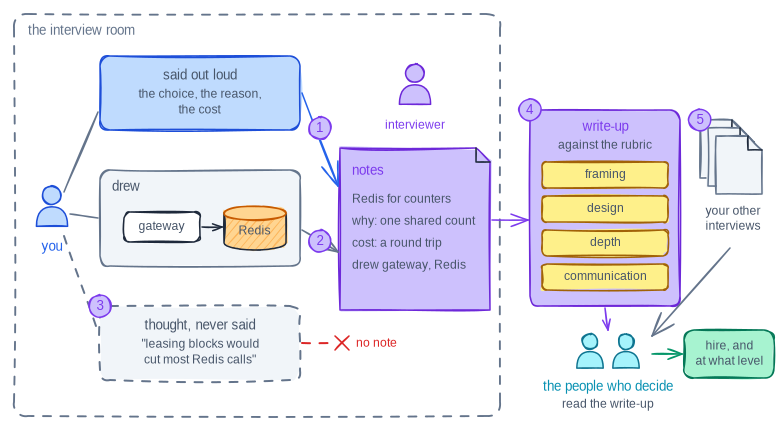
Each heading is also read against your level. Medium's rubric says system design grading "will depend on the type of interview and the seniority of the candidate." "Reached a working design once the interviewer suggested the structure" is a fair note for a mid-level candidate. For a senior candidate, who is expected to drive, the same note is weak.
Where the signal comes from
Interviewers call the thing a note is made from signal: anything you say or do that they can write under one of their headings, for you or against you. The four headings do not get it at an even rate.
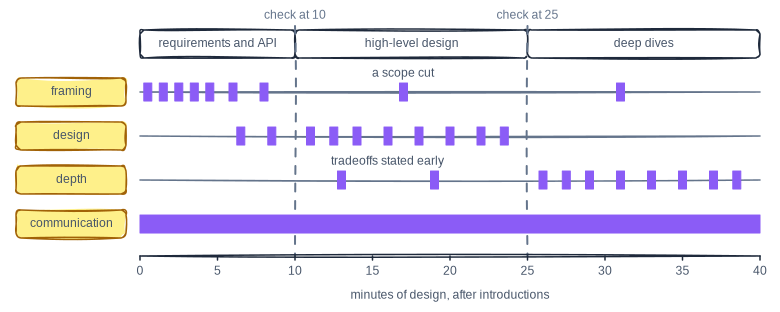
Communication gets signal in every minute, including the minutes you spend thinking, so most of the habits below are about what to say out loud. The first five minutes covers the framing at the start in detail.
The question is when to stop adding boxes and start a deep dive.
Take the time that is not design out of the slot, then lay the
phases on what is left.

  slot                                          45 min
  introductions, your questions at the end      ~5 min
  ────────────────────────────────────────────────────
  design time                                  ~40 min

  requirements and scope        minute  0 to  5
  entities and the API          minute  5 to 10    check at 10
  high-level design             minute 10 to 25    check at 25
  deep dives                    minute 25 to 40

If the high-level design runs on to minute 35:
  time left for deep dives      40 − 35      =   5 min
  time planned for deep dives                =  15 min
  → depth gets a third of its planned time

At minute 25, stop adding boxes and choose a deep dive.
Four habits to note.
- Say each choice in three parts: the choice, the reason, the cost. "Redis for the counters, because counts kept in each gateway cannot hold a global limit, and it costs a round trip on every request." That one sentence puts a note under design and a note under depth.
- Write the numbers on the board. A number on the board can be copied into the notes and pointed back to when it settles a choice. Back-of-envelope estimation covers which numbers to work out.
- Say what you are leaving out, and why. A cut you name is framing signal. A part you skip without a word looks like a part you forgot.
- Propose a deep dive, and say why that one. If the interviewer steers elsewhere, follow. Amazon asks for breadth plus "expertise in one area," so propose an area you know well.
The same answer, three ways
Here is one choice from the rate limiter: where the request counters live, at 1 million requests a second through 200 gateway instances, with each client under its own limit. All three answers below put the counters in Redis.
Name the component
"The counters go in Redis." The box goes on the board, and the candidate moves on.
This is tempting because it is correct and it saves a minute. The notes get one line under design: "shared Redis for counters." There is no reason to record, so nothing goes under depth.
Name it, give the reason, state the cost
"Each gateway could count on its own. But with 200 instances behind a load balancer, a limit of 1,000 a minute turns into anything from 1,000 to 200,000, depending on how requests spread. So the count has to be shared: one counter per client in Redis, checked on every request. That costs a Redis round trip, about 1.5 ms within one availability zone, and it makes Redis a dependency of every request."
This is the standard answer, and the notes now have something under three headings. Design gets the shared counter. Depth gets a rejected option, ruled out with a number, and a cost stated before anyone asked. Communication gets a choice explained in the order it was made. The staff answer starts from that cost.
Question whether every request needs Redis
"Keep Redis as the source of truth, but take it off the path of most requests. For clients with large limits, each gateway leases a block of tokens in one call and spends it from memory. If every gateway holds a full block, the limit can be overshot by 200 times the block size, so to stay within 5 percent a block can be at most 0.05 × limit / 200. Below about 4,000 a minute that is less than one token, so small limits still go to Redis on every request. If 90 percent of traffic sits under large limits, Redis sees about 118,000 calls a second instead of 1 million."
The notes under depth now hold a premise questioned, a bound worked out, and a limit on where the idea applies. The rate limiter's level section asks staff candidates for this: question whether the data store belongs on the request path, then put a bound on the answer.
Where it goes wrong
These are five ways a good design ends up with thin notes.
1. Thinking in silence
Silence while you think is allowed. Google's tips say you can tell the interviewer "you want a few moments to collect your thoughts."
The cost comes when you end the silence with only the result. Two minutes of thought that end in "OK, a cache here" produce one note. The same two minutes followed by what you ruled out, and why, produce three. So say that you are going to think, then think, then say the conclusion and how you reached it.
2. Treating a question as a verdict
The interviewer asks "what happens if Redis goes down?" If you hear that as "your design is wrong," you start taking the design apart. Often it is the next question on a list, and Google's tips say to "expect some follow-up questions." In Amazon's system design prep video, a software development manager says an interruption "doesn't necessarily mean that they're not happy with the answer."
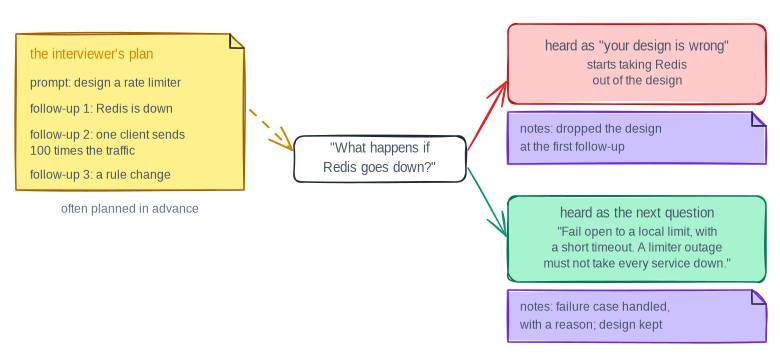
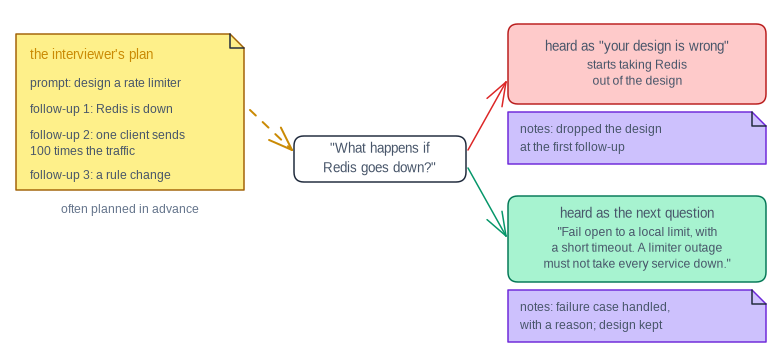
The opposite mistake is to dig in when the interviewer's hint is right. If a follow-up exposes a hole in the design, say so, change the design, and say what the change costs. That is addressing feedback too.
3. Running out of clock before the deep dive
An overrun in the high-level design comes out of the deep dives, and depth gets most of its signal there.
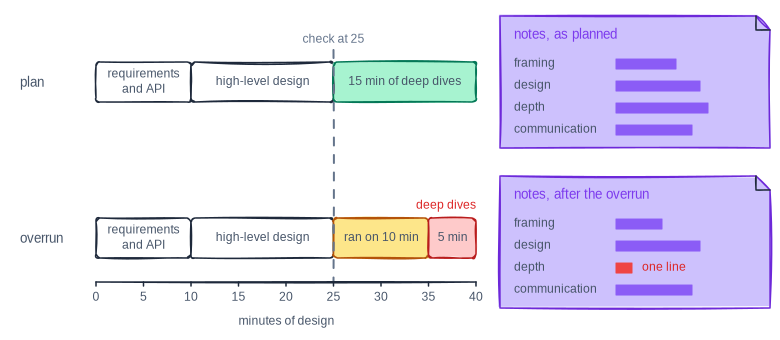
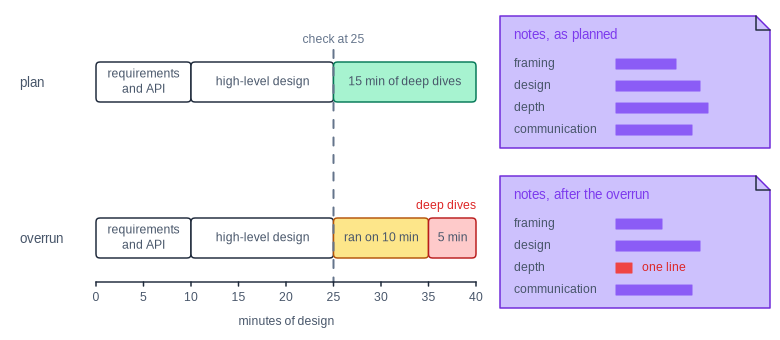
4. Collecting requirements and never using them
Amazon's system design prep video says: "a lot of times we end up getting requirements but not using them in the design." A requirement you collected and never used produces one note, early. A requirement you name again when it forces a choice produces a second note, under depth. "We said approximately correct is fine, so the gateways can lease quota" turns the rate limiter's accuracy requirement into the reason for a design choice.
5. Bluffing on a topic you do not know
Amazon's tips say that if you are asked to go deep on a topic you do not know, you should tell the interviewer and suggest one you do know. Meta's guide says "it's ok if you don't know!" and asks you to be upfront about topics you have less experience with.
"I have not run Kafka in production, but here is how I would reason about it" gives a note about how you reason. A wrong answer given with confidence gives a note about the wrong answer.
More of these, each with its fix, are in The Ten Most Common Ways Candidates Fail. How to keep the board readable while you talk is in Drawing Diagrams Under Time Pressure.
If you remember nothing else
| fact | so |
|---|---|
| The decision is made from the feedback | Say the choice, the reason and the cost |
| Meta lists four separate areas | Give each one signal on purpose |
| Communication is assessed every minute | Say when you are thinking, then what you concluded |
| Depth comes last, so the clock threatens it | Check the clock at minute 10 and minute 25 |
| Follow-ups are often planned | Answer them, say what changes, carry on |
| The bar moves with the level | Mid: a working design. Senior: drive it. Staff: decide what not to build |
What is expected at each level
What each level does differently on the same question is in What Separates Mid, Senior and Staff.
Mid-level
Breadth matters more than depth at this level, and it is fine to be led through the structure.
The notes need a working design from end to end, with a reason beside each main choice, and sensible answers once the interviewer raises a deep dive. You are not expected to raise failure modes or detailed sizing on your own.
Senior
You drive the structure, and the notes should show three things you raised without being asked.
A reason and a cost for every main choice. A reason that arrives only after a prompt shows the interviewer leading, and a senior candidate is expected to lead.
Numbers that changed a choice. Every breakdown asks senior candidates to size the system and act on the result. A size you calculated and never used does not count.
The failure the question is built around. Examples are Redis going down in the rate limiter, and a chat server dying with its sockets in WhatsApp. If you raise it before the interviewer does, the notes get depth signal that nobody asked for.
If the interviewer has to supply the structure, or the notes reach the end with no tradeoff stated, the write-up reads as mid-level, whatever the diagram looks like.
Staff+
A correct design is still the bar. A staff+ answer also decides what not to build, and says so where the interviewer can write it down.
Question a premise, and size what it buys. Leased quota in the rate limiter is the model: an assumption named, a trade made on purpose, and a bound worked out.
State early the fact the design rests on. In the URL shortener, a mapping never changes once it is written. In WhatsApp, the server is a relay, not an archive. If you say it in the first few minutes, later choices follow from it.
Be able to say what you would not build, and say it as a list. In the rate limiter that is coordination between regions on every request, exact counting, a queue for rejected requests and persistence on the counters. In the URL shortener it is reuse of expired codes, an analytics write on the request path and hard deletes. A team could spend a quarter on any one of these, and one sentence naming it as a deliberate omission puts a staff note on the page.
Sources
Every claim here about how a company runs or grades its interviews comes from one of these pages.
- Meta, Preparing for your full loop interview. Focus areas, loop, tradeoffs.
- Amazon, Software Development Engineer III (SDE III) interview prep. Objectives, tips, the prep video.
- Amazon, Amazon Bar Raisers. The debrief, and who decides.
- Google, Interviewing at Google and Our hiring process. Rubrics, thought process, follow-ups.
- Google re:Work, A guide to structured interviewing. Rubric anchors and notes.
- Jamie Talbot, Medium Engineering, Engineering interviews: grading rubric, 2016. A full published rubric.