A candidate can explain consistent hashing, write the Lua script for a Redis counter and size a Kafka cluster, and still fail the design round. The knowledge was there. They used it on the wrong part of the problem, or they never said it out loud.
The companies say what they want. Meta's guide for the design round expects you to drive the conversation. Amazon's prep page asks you to compare the designs that would work, pick one and justify it. Google's interview tips ask you to say when you are making an assumption, or going deep instead of broad, and to "explain why you're making that call." All three ask for choices, made out loud.
Every failure on this list is a choice: one you never made, or one you made where the interviewer could not see it.
The ten come from the mistakes the course's breakdowns warn about, and picking these ten is a judgement. Each one counts against you in one of the four focus areas Meta assesses. No company publishes how often each one happens, so this page gives no rates. The ten are in the order they turn up in the 45 minutes.
How the interviewer's notes become a grade is in How a System Design Interview Is Scored. How the bar moves between levels is in what separates mid, senior and staff.
Scoping and the first sketch
The first 5 minutes decide which system you design, and the sketch after them shows how you got there.
1. Designing the version you prepared
The YouTube breakdown opens on the answer most candidates give: they upload the bytes, store them and put a content delivery network (CDN) in front. It is the design they practised for Instagram, with bigger files, and it leaves out what makes the question YouTube.
Each upload is transcoded (decoded and encoded again) into renditions, copies of the video at different sizes and bitrates. Each rendition is cut into segments a few seconds long, and the player picks a rendition again before each segment. Instagram resizes photos too, but serves whole files.
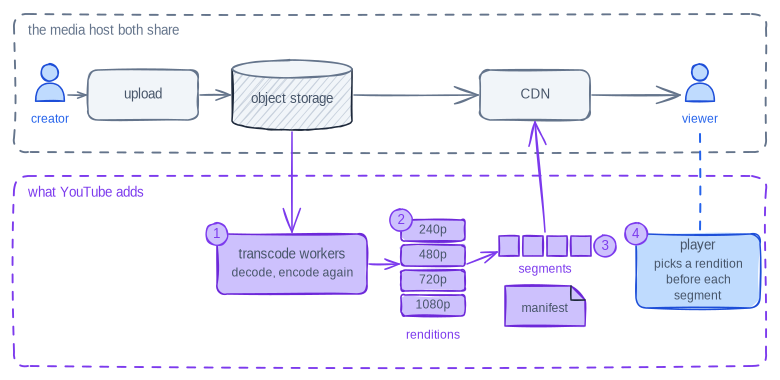
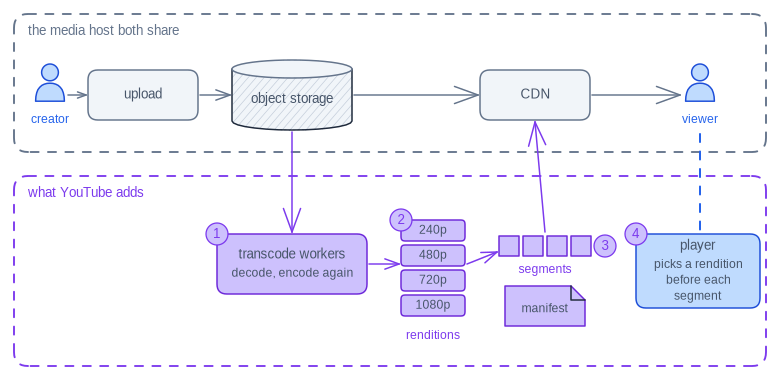
The same thing happens on other questions. The Instagram breakdown says most candidates spend 40 minutes on the feed, when the question is mostly about the media. In the rate limiter, candidates compare five algorithms for 15 minutes and never say where the limiter runs.
The interviewer expects the shared part, so it tells them little. They learn most from the part this question has and its neighbour does not. Before you draw, name that part, and say you will spend the design time on it. Otherwise the choice of what to design was made before the interview, by what you happened to practise. Splitting the name of a system comes before this, and the first five minutes covers it.
2. Opening with the conclusion
"We use WebSockets." "Fanout on write, with a hybrid for celebrities." Both are right answers to their questions, given in the first sentence with the reasoning left out.
Google's tips say the interviewer "will be looking to see the thought process versus the answer itself." A conclusion with no path to it shows no thought process. The interviewer cannot tell it from one you read an hour ago. And when they ask why, you have to rebuild the reasoning under pressure. Ending a silence with only the result has the same cost.
So start where anyone would start, price that option with one number, then step up from there. The news feed breakdown starts from the query a feed needs on every load. 300,000 feed loads a second, each looking up 200 followed accounts, is 60 million lookups a second. That number forces the feeds to be built in advance, and now you have shown why.
In WhatsApp, walking from polling to long polling to server-sent events to WebSocket, and ruling each one out by what it fails at, takes about 90 seconds.
Building the design
From about minute 10 to minute 25, the boxes go on the board.
3. A box with no reason and no cost
"Kafka between these two." "Cassandra for the posts." The box is on the board, and nothing beside it says why it won or what it costs.
Amazon's page asks you to compare the options, "select one, and justify your decision." Meta's guide says "Avoid focusing on only optimal solutions," and asks to see how you think through tradeoffs. A box with no reason gives the interviewer no comparison and no tradeoff to write down.
A candidate who gives a reason can still leave out the cost, and the cost is where the follow-up goes. If you put Redis on every request and do not say that it adds a round trip and a dependency, the interviewer will ask. Your answer then sounds like a concession instead of a choice.
Say each choice in three parts: the choice, the reason, the cost. The scoring page shows one Redis choice given three ways.
4. Numbers that decide nothing
The candidate spends the first 5 minutes on daily users, requests a second and storage a year. They write the totals on the board and never look at them again.
Or they size the obvious resource and miss the one that runs out. Four breakdowns name their own version. In WhatsApp it is sizing the message database and never the connections. In the URL shortener it is the database and never the cache. In Instagram and YouTube it is storage and never egress, the bytes sent out to viewers.
A number is useful only when it changes a choice. Size each resource on its own, and say which one sets the design. In the rate limiter, 18 million live keys at about 200 bytes each is 3.6 GB, which fits on one Redis node. 1 million checks a second, at about 100,000 per shard, needs 10 shards, and about 20 with headroom. So the cluster is sharded for operations a second, not for data. Say that sentence out loud.
Back-of-envelope estimation covers which numbers to work out, and the first five minutes covers the unit that runs out.
5. Building what nothing asked for
The candidate adds consensus, replication across regions, a queue and a sharded database, because a large company would run them.
The rate limiter breakdown calls this the trap its question is built around. A candidate accepts "exact and global" as a requirement, then spends 20 minutes designing consensus for a component whose job is to be cheap and fast. Choosing a database has the storage version: Cassandra picked for write throughput at 400 writes a second, which is 2 to 8 percent of what one Postgres primary commits.
Each extra component is one more thing to defend, and its minutes come out of the parts the question is about. The choice you skipped is what not to build.
So test each component. Name the number that forces it, and set it beside what the simpler option handles. If the simpler option covers it, leave the component out. The rate limiter keeps its counters in memory with persistence turned off, because a counter is useless after one window, and durability buys nothing a user would notice.
Promising more than the product needs, such as exactly-once delivery, is the same failure made in the requirements. The first five minutes covers that version.
6. Spending the middle on the easy part
The URL shortener breakdown opens on candidates who spend 20 minutes generating short codes. They hash the URL, switch to a counter written in base62, and add a retry loop for collisions. The click analytics carry 100 times the writes and get a footnote.
In WhatsApp it is a large message table designed first. Its level section says that if you are 20 minutes in and still on the schema, you have answered a different question.
Before you spend 20 minutes on a component, work out what load it carries.
The question is whether code generation needs a scaling
plan, or whether the time belongs somewhere else. Each writer
takes a block of 10,000 codes from the shared counter in one
call. Work out how often that call happens, then set it
beside the clicks.

  links created         100M a day / 86,400 s   ≈  1,157/s
  peak, at 3x average                           ≈  3,500/s
  calls to the counter  3,500 / 10,000          =   0.35/s
                                                ≈  one every 3 s

  click events          10B a day
  clicks per link made  10B / 100M              =      100
──────────────────────────────────────────────────────────
One call every 3 seconds needs no scaling plan. The clicks
are 100 times the writes, so the deep dive goes there.
The scoring page shows what an overrun does to the deep dives. Keeping the board itself quick is the subject of drawing diagrams under time pressure.
Going deep
From about minute 25, the interviewer wants detail.
7. Waiting to be told where to go deep
The high-level design is done, and the candidate asks, "What would you like me to go into?" with no proposal of their own, then waits. Or they answer each prompt well and never propose anything.
Meta's guide says the question will be high level and "it will be up to you to drive the conversation." Picking the deep dive is part of driving. If you leave the pick to the interviewer, you hand over a choice that would have shown whether you know where your design is weakest.
Propose one, with a reason, then ask if that suits them. "The risky part is the connection registry. When a chat server restarts, 1 million sockets drop and every client has to find a new server, so I'd like to start there." If they steer somewhere else, follow.
Amazon's prep video for senior engineers tells you to ask which areas the interviewer wants you to go deeper into, and a proposal gives them something to agree to. The scoring page lists the same habit, and says why to pick an area you know well.
8. Boxes with no mechanism
"A websocket layer." "A cache in front." "Redis does the counting." Each box is right, and when the interviewer asks how it works, the answer stays at the level of the box.
Meta's guide asks, "Can you dive into the technical details when needed?" In the rate limiter, a check reads the count, decides, then writes. If you never say those three steps must be one operation, two gateways can both read 999 against a limit of 1,000, and both allow. The breakdown says this usually ends a senior loop. The fix is one atomic INCR, or a Lua script that runs the whole check inside Redis.
In WhatsApp, the detail is where the mapping from device to server lives, and what happens to it when a server dies. In the news feed, a cursor that holds only a timestamp skips or repeats posts written in the same millisecond.
For each box on the request path, be ready to name the key, the command or the field that makes it work. If you do not know one, say so, and offer a part you do know. Amazon's page asks for that, and the scoring page covers why bluffing costs more.
9. Only the happy path
The design works while everything is up. Nothing on the board says what happens when Redis stops answering, a chat server restarts, or a queue backs up.
Meta asks how you are "mitigating potential risks and failure points." Amazon asks you to address "operations and resilience in addition to solving your customer's problem," including failure points and redundancy.
Each part needs a planned behaviour for when something it depends on fails. If you do not choose one, the code's default chooses for you.
In the rate limiter, a call to Redis with no timeout makes every request wait until the network gives up. The gateway's pool of connections fills, and the service stops serving. That happens even if the plan was to fail open, letting requests through when the check cannot run. Failing closed, rejecting every request, turns a Redis outage into a total outage. The breakdown says getting this wrong is disqualifying more often than any algorithm mistake.
For each part that holds state, say what happens when it is gone, and what the user sees. Then raise the failure the question is built around before the interviewer does, as the scoring page's Senior level asks. In the rate limiter that is Redis going down. In WhatsApp it is the reconnect storm on every deploy, when the 1 million devices on a restarted server all try to connect again at once.
10. Starting again when the question changes
The interviewer changes a requirement. "Now make the feed ranked." "What if traffic grows ten times?" The candidate erases the board and starts a new design. Amazon's page lists the second question among the ones to settle while scoping: "What does twice the growth look like? Or ten times the growth? How would that influence your design?"
Starting again throws away choices that still hold. It also suggests you do not know which part of your design rests on which requirement. The news feed breakdown shows the other answer. The fanout stays as it was, and each timeline now holds a larger set of candidate ids instead of the final order. Ranking is one new stage at read time, and the ranked order is frozen for the session, so the cursor stays valid. Saying that takes about 15 seconds.
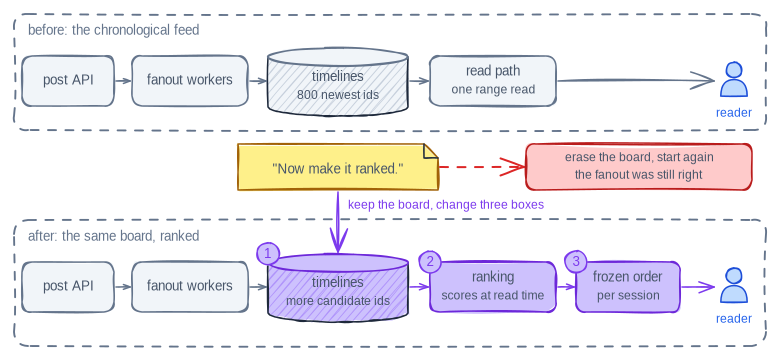
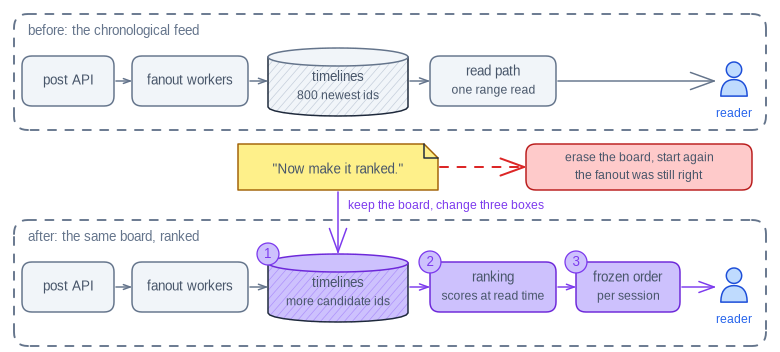
Name the requirement that changed and the choices that rested on it. Change those, and keep the rest. A follow-up that only probes a weak spot needs less than that: answer it and carry on, as the scoring page describes.
If you remember nothing else
| failure | the choice to make out loud |
|---|---|
| 1. The version you prepared | What this question has that its neighbour does not |
| 2. The conclusion first | The obvious option, priced, then step up from there |
| 3. A box with no reason | The choice, the reason and the cost |
| 4. Numbers that decide nothing | Which resource runs out first |
| 5. Building what nothing asked for | The number that forces each component |
| 6. The easy part, at length | What load each component carries |
| 7. Waiting to be led | Which deep dive, and why that one |
| 8. Boxes with no mechanism | The key, the command or the field |
| 9. Only the happy path | What happens when each part that holds state is gone |
| 10. Starting again | Which choices the change touches |
What is expected at each level
Mid-level
The failures that cost most at this level are the first and the sixth: a design for a different question, or one that never reaches the end. You are expected to reach a working design, with a reason beside each main choice. You may be led into the deep dives, and you are not expected to raise failure modes on your own.
Senior
You drive, and you pick the deep dive yourself. Beyond that, three of these failures weigh more at this level.
A main choice with no cost. A cost you give only when asked shows the interviewer leading.
Sizing that changes nothing. The breakdowns expect you to find the resource that runs out and design for it.
No failure story. Raise the failure the question is built around before you are asked.
Staff+
A correct design is still the bar. The failures that cost most here are the fifth and the tenth: machinery that nothing asked for, and not knowing which choice rests on which requirement.
Be able to say what you would not build, as a list. In this course that means no exact global counting in a rate limiter, and no server-side message history in WhatsApp. It also means no scaling plan for the URL shortener's write path, and no fanout to inactive users in the news feed.
Sources
The company guidance quoted on this page comes from these four sources.
- Meta, Software Engineer Full Loop Interview Guide, linked from Meta's onsite prep page. Driving the conversation, the four focus areas, tradeoffs, technical detail, and risks and failure points.
- Amazon, SDE III Interview Prep. Comparing options and justifying one, operations and resilience, and the growth questions to settle while scoping.
- Amazon, Prep Series Episode 2 transcript, linked from the SDE III page. Asking which areas the interviewer wants you to go deeper into.
- Google, Interviewing at Google. The thought process over the answer, and explaining each call.