Candidates preparing for a senior or staff interview often make the design bigger. They add a second region, a queue between every pair of services and a cache in front of everything. The interviewer then sees more boxes, with the same reasoning behind each one as before.
The published criteria do not change with the level. Amazon publishes interview prep pages for two engineering levels: Software Development Engineer II (SDE II), and SDE III, which it also calls Senior Software Engineer. The system design part of both pages lists the same six objectives, from practicality to scalability, and the same question tips, word for word. Meta's candidate guide gives its design interview one set of four focus areas, and does not split them by level.
The job descriptions on the two pages differ. An SDE II will "contribute to your team's software". An SDE III will "have a system-wide, architectural view of the solutions you build". The SDE III page also adds notes on high-level and low-level design.
The course's breakdowns show the same thing from the answer side. Every contested decision in them is answered three times, at tiers called naive, senior and staff, and every breakdown closes with what each level is expected to show. In several of those decisions, the senior and staff answers use the same components. They differ in what the candidate asks about those components. How a system design interview is scored covers how the interviewer writes an answer down. This page is about what goes into the answer at each level.
Mid asks whether the design works, senior asks what it costs, and staff asks which assumption is paying that cost.
What each level is asked to show
Read side by side, the six breakdowns' level sections agree on what changes between levels.
Mid-level: a working design, and you may be led. Four of the six say breadth matters more than depth at this level. The same four list the hard parts of the question, and expect a mid-level candidate to reason about them once the interviewer raises them. In the rate limiter, those are hot keys, the control plane and atomicity. Atomicity means the read, the decision and the write on a counter happen as one step.
Senior: you drive, and some things appear without prompting. Four of the six name exactly three such things. All six ask senior candidates for sizing.
Staff+: a correct design, and what it can do without. The rate limiter and the URL shortener say a correct design is still the bar. WhatsApp and the news feed say the job shifts to spotting which assumptions, or which numbers, carry the design. Four of the six end with a list of what not to build.
| breakdown | senior | staff, on top of that |
|---|---|---|
| Rate limiter | Redis sharded for operations a second, not data size | Leased blocks of quota keep most requests off Redis, with a bounded overshoot |
| URL shortener | 150 TB stored, but what is read fits in RAM | A mapping never changes, so it is cached forever |
| Fleet sized by sockets, not messages | A relay, not an archive: 18 PB becomes 4 TB | |
| News feed | The read-time query, priced and rejected | The celebrity threshold, derived |
| Direct uploads, justified by bandwidth | A 15-point swing in cache hit ratio changes the origin fleet 4x | |
| YouTube | Storage and outbound bandwidth sized | 1,400 watch-hours per uploaded hour prices every decision |
None of the staff entries in the table adds a component. Each one decides how much of the design you need.
Mid to senior: say it before you are asked
The mid and senior sections often name the same topic. The rate limiter's mid-level section says you do not have to raise atomicity yourself. Its senior section puts atomicity first among the three things you must raise yourself. Both levels need to know the answer. The difference is who brings it up.
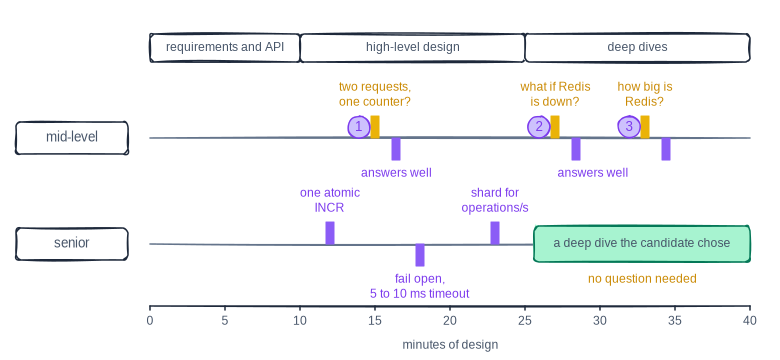
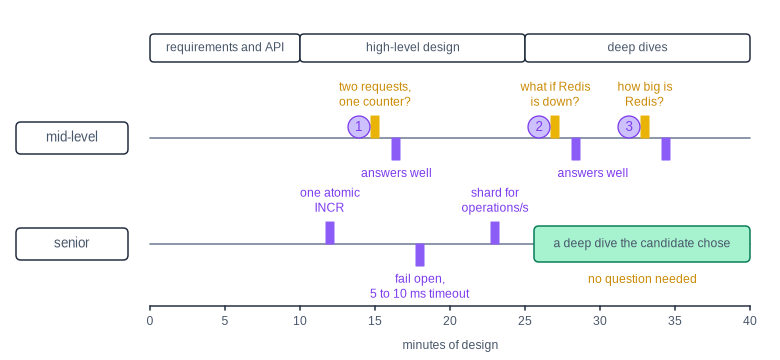
Three things move a mid-level answer to a senior one, and none of them is a new box.
The case that breaks the obvious design. Each question has one. In the rate limiter it is Redis going down. In WhatsApp it is a chat server dying with its sockets, and in the news feed it is a post from an account with 100 million followers. A senior candidate raises it while drawing the design.
A number that changes a choice. The URL shortener shows which size counts.
Sizing what is stored picks the data store. Sizing what is
read is the step the breakdown's senior section asks for.
The inputs: 100 million new links a day, kept for 10 years.

Stored
  links    100M/day × 365 × 10              = 365B
  rows     365B × ~400 B                    ≈ 150 TB
  → too big for one Postgres; a distributed key-value store

Read, assuming ~90% of redirects go to links under a week old
  links created in 7 days    100M × 7       = 700M
  of those, ever visited     ~20%           = 140M
  cache    140M × ~200 B per entry          = 28 GB
─────────────────────────────────────────────────────────────
The first number picks the data store. The second says that
nine redirects in ten can be answered from one machine's RAM,
which is what makes the system cheap to run.
The cost of your own answer. A senior answer says what its own choice costs before the interviewer finds it. In the rate limiter that sounds like: "Fail open with a timeout of 5 to 10 ms. Redis is often unhealthy because the system is under stress, so this removes the limit at the moment we need it most."
Senior to staff: question what the cost rests on
Many staff moves start where the senior answer stopped, at the cost it named. In these four decisions, the senior tier ends by naming the risk that is left, and the staff tier starts from it.
| decision | the senior tier ends on | the staff tier |
|---|---|---|
| Rate limiter, Redis is down | Failing open drops the limit when it is most needed | Fails open to a rough local limit |
| URL shortener, a takedown | A lost purge leaves no trace | Pushes a versioned list of disabled codes to every edge location |
| News feed, fanout falls behind | The lane for large accounts can still lag | The read path tops up a stale timeline |
| WhatsApp, a server dies | Jitter spreads reconnections but does not reduce them | Makes each failure smaller |
The move can be written as four steps.
- Take the cost the senior answer named.
- Find the assumption that makes that cost necessary.
- Check whether any requirement asks for that assumption.
- If none does, trade it. Say in numbers what the trade buys, and say what it gives up.
WhatsApp's chat servers show all four steps. Each server holds 1 million sockets, which is what WhatsApp reported running per server. When a server restarts, 1 million phones lose their connection at once. That happens on every deploy, not only during incidents.
The senior answer has each phone wait before reconnecting, and wait longer after each failed try. This waiting is called backoff. A random delay added on top, called jitter, spreads the 1 million reconnections over a minute. The senior answer also names its own cost: the total is still 1 million, so the fleet needs room for all of them.
The staff answer asks why one failure involves 1 million phones. Two assumptions sit under that number: one server holds 1 million sockets, and a restart drops every socket. Neither is a requirement. The requirements include 100 million live sockets at peak, delivery within 500 ms for 99 of every 100 messages (p99), and nothing lost once accepted. They say nothing about how many sockets one server holds, or about restarts.
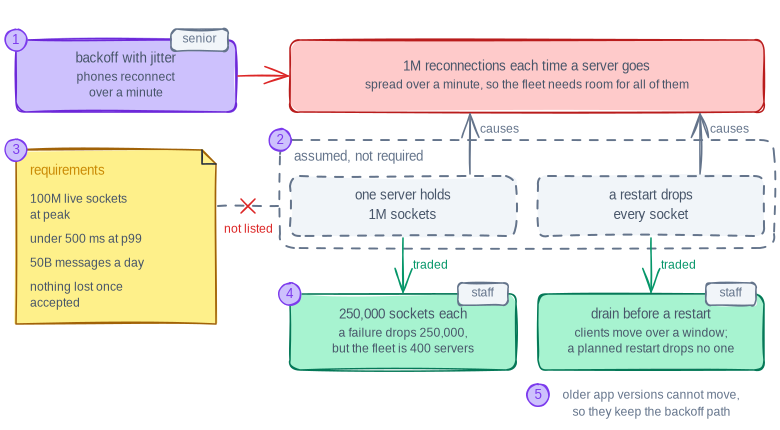
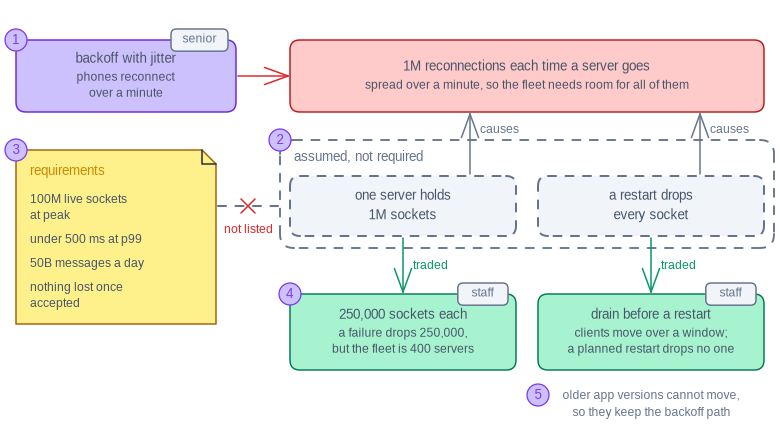
So both can be traded. At 250,000 sockets per server, a failure disconnects 250,000 phones instead of 1 million, and the fleet grows from 100 servers to 400.
A server that is shutting down on purpose stops taking new connections. It tells its clients to reconnect elsewhere, spread over a few minutes while it drains, so a planned restart drops nobody. The cost is that clients have to support being moved. Older app versions do not, so the backoff path stays for them.
Run the check against the requirements out loud, so the interviewer hears that you are keeping every requirement. The first five minutes covers how to word requirements narrowly enough to check against.
The celebrity problem, three ways
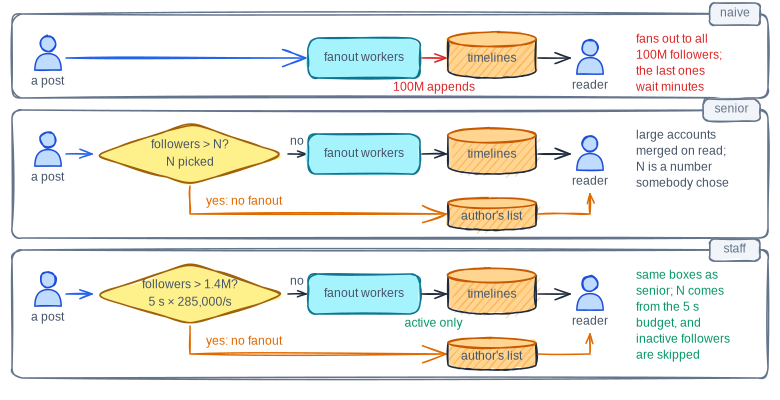
Here is one decision from the news feed, answered at each tier: what happens when an account with 100 million followers posts. The requirement the design rests on says a post may take seconds to appear in a follower's feed. Twitter reported that delivering one post to 1 million followers took 3.5 seconds at the median, and up to 5 minutes at p99.
Fan out to every follower, and add workers
"Each post goes on a queue, and fanout workers copy it into every follower's timeline. If that gets slow, I add workers."
This is tempting because it is the design that works for every ordinary account. It breaks on the big one. Twitter's figure is for 1 million followers, and 100 million is 100 times the work for one post, arriving as one burst. The last followers see the post minutes late, and every post queued behind it waits too.
At mid level, this is an acceptable place to start. The news feed's mid-level section does not expect the celebrity case unprompted, only reasoning about it once the interviewer raises it.
Skip fanout above a threshold, and merge at read time
"Above some follower count, I do not fan out. The account's recent posts stay in one list, and each reader merges in the few large accounts they follow. That list has 100 million readers, so nearly every read of it is a cache hit."
The candidate raises the celebrity case before being asked, and gives a reason. They also name the cost: a feed read is now a range read plus a merge, so the read side has two paths instead of one. One thing is left open. The threshold is a number somebody picked.
Derive the threshold from the freshness requirement
"We said a post may take seconds. Take 5 seconds as the budget. Twitter's median figure works out to about 285,000 deliveries a second for one post, so 5 seconds reaches about 1.4 million followers. That is the threshold, and at 10 seconds it would be about 2.9 million."
This drops the idea that the threshold is a setting somebody tunes. It now follows from a requirement, so a product decision about freshness turns directly into an infrastructure number.
The rule underneath, only precompute what somebody will read, also covers followers who have not opened the app recently. Fan out only to active followers, and build a timeline for anyone else when they come back. That removes part of the 20 billion writes a day that land in timelines nobody opens that day. The cost is a last-seen timestamp per user, and a slower first load for someone returning after months.
Where it goes wrong
These are mistakes in pitching the level. The ten most common ways candidates fail covers the rest.
1. Removing a cost before it is on the board
A staff move that removes a cost needs that cost on the board first.
The rate limiter's leased quota is one such move. Each gateway takes a block of tokens from Redis in one call and spends it from memory. If you open with it before the counters are in Redis, there is no cost on the board for the lease to remove. There is also nothing to lease from: each block comes out of the shared counter in Redis. Build the senior answer, name its cost, then take the step.
This holds for trades, not for facts. Facts the design rests on, like WhatsApp's server being a relay, still belong in the first minutes.
2. Adding components to look senior
More boxes do not raise the level. In WhatsApp, the naive tier puts a broker such as Kafka between chat servers. A publish that waits for the record to land on more than one broker takes 5 to 20 ms, against a budget of 0.5 to 2 ms for the hop between servers. In the staff tier, the sender looks up the recipient's server in the registry once. Then it writes to a connection the two servers keep open.
The staff answer adds no tier. It removes the broker. Drawing diagrams under time pressure covers what belongs on the board.
3. Trading a requirement instead of an assumption
An assumption is yours to trade only when no requirement asks for it. WhatsApp can drop history on the server, because nothing on its list asks for it. That turns an archive growing 18 PB a year into a spool of about 4 TB. It cannot make the spool lose messages, because "nothing is lost once accepted" is a requirement.
If you remember nothing else
| Mid | A working design with a reason per choice, and the hard parts once raised |
| Senior | Raise the case that breaks the obvious design, a number that decides, and your own cost |
| Staff | State the facts the design rests on early; start each trade from a named cost |
| The trade | Assumptions can go; requirements stay |
| The boxes | More of them is not a higher level |
What is expected at each level
Mid-level
Reach a working design, with a reason beside each main choice, and reason through the hard parts once the interviewer raises them. Starting from the naive answer is fine, as long as you move off it when the problem is pointed out. You are not expected to question the assumptions under the design.
Senior
You drive, and three things appear without prompting.
The case that breaks the obvious design. Examples are the celebrity post in the news feed, a dead chat server in WhatsApp and Redis going down in the rate limiter.
A number that changes a choice. In the URL shortener, it is a 28 GB hot set, the part that is read, against 150 TB stored.
The cost of your own answer, said before the interviewer finds it. It is also where a staff answer starts.
Staff+
A correct design is still the bar. A staff answer then decides how much of it is needed.
State early the fact the design rests on. In WhatsApp the server is a relay, and YouTube opens with 1,400 watch-hours per uploaded hour.
Start from the senior cost, and find the assumption under it. Check it against the requirements before trading it, then size the trade: 250,000 sockets per server, and 400 servers instead of 100.
Derive a number instead of picking it where a requirement allows, as the news feed does with its threshold.
Say how it fails and how you change it safely. In the rate limiter, a new rule runs in shadow mode, logging what it would reject, then rolls out in stages with a versioned rollback.
Be able to say what you would not build. In the news feed: fanout to inactive users, deleting posts from every timeline, offset pagination, and a consistency guarantee between different users' feeds. In WhatsApp: read receipts fanned out in large groups, presence on the durable path, and a promise of exactly-once delivery. A team could spend a quarter on any one of these.
Sources
Company practice is from each company's own candidate pages, the Twitter and WhatsApp figures from published accounts, and every other figure from the course's breakdowns.
- Amazon, SDE II Interview Prep. The SDE II job description, the design objectives and the tips.
- Amazon, SDE III Interview Prep. The SDE III job description, with the same objectives and tips.
- Meta, Software Engineer Full Loop Interview Guide, linked from Meta's onsite prep page. One set of four focus areas for the design interview, with no split by level.
- High Scalability, The Architecture Twitter Uses to Deal with 150M Active Users. Delivery to 1 million followers in 3.5 seconds at the median and up to 5 minutes at p99, and merging large accounts at read time.
- High Scalability, How WhatsApp Grew to Nearly 500 Million Users. 1 million connections per chat server.